0
0

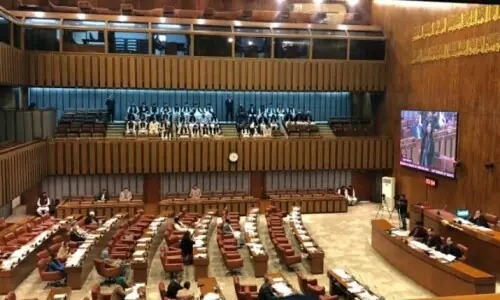
THE inter- and intra-institutional battles continue apace. With rumours and speculation at fever pitch, the National Assembly and Senate convened late Saturday afternoon, ostensibly to debate amendments to the Constitution.
However, soon after sessions commenced in the two Houses, it became clear that nothing dramatic was planned for the day. The opposition and treasury benches seemed more interested in trading barbs and attacking each other’s democratic credentials, while there was little discussion on the ‘constitutional package’ that was supposed to be tabled. As the day wore on, speculation picked up that the government had failed to lock down the votes it needed. Even with its allies, it seems to be short of the required two-thirds majority in both Houses. Furthermore, a Supreme Court judgment in the field on Article 63-A ensures that even if opposition legislators are induced to vote against their party lines, their votes will not count.
While these debates and discussions were playing out in parliament and on television talk shows, a bolt landed from the blue. The Supreme Court issued a long-awaited clarification in connection with its earlier ruling in the reserved seats case, directing the Election Commission of Pakistan to immediately notify all remaining PTI lawmakers as members of its parliamentary party. This gave finality to the status of 41 lawmakers that the government had been describing as ‘independents’, whose votes were up for grabs.
As things now stand, making constitutional amendments while remaining within the bounds of propriety and the law seems like an increasingly difficult task. The government should be asked why it set about attempting to change the Constitution in such a furtive manner. Few seem to know what is in its legislative package, and with the opposition accusing it of pressuring lawmakers to vote for it, it seems like a thoroughly undemocratic exercise overall.
Lastly, a word too on the ECP, one of the primary actors responsible for the growing political mess in Pakistan. Yet again, its actions have been found to be in bad faith and violative of the law. Not only that, the Supreme Court has also slammed its attempt to delay implementation of the July reserved seats verdict by seeking ‘clarification’ on the PTI’s organisational structure. The “attempt by the ECP to confuse and cloud what is otherwise absolutely clear as a matter of the Constitution and the law must […] be strongly deprecated,” the court has noted, warning it of consequences if it tries to delay issuing the notifications any longer.
Perhaps it is time that the institutions propping up the current regime realised that the state is sinking deeper in crisis not just because of the PTI, but also because their own actions are gradually robbing it of all legitimacy.
Published in Dawn, September 15th, 2024