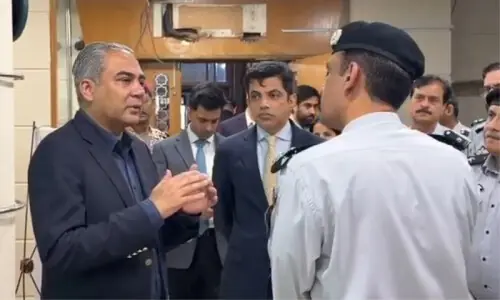
KARACHI: Key stakeholders, including government officials, rights activists, representatives of civil society and children participated in a consultation meeting on the Sindh Bonded Labour System (Abolition) Act, 2015, and child domestic labour in Sindh on Wednesday.
The Sindh Human Rights Commission (SHRC), in collaboration with Obun2, organised the event at a local hotel here.
The consultation aimed to identify gaps and develop a framework for legal and institutional reforms to eradicate bonded labour and child domestic labour in Sindh.
The SHRC raised concerns about the police’s failure to include proper sections of the Sindh Bonded Labour Abolition Act in FIRs.
Labour minister says loopholes in laws will be addressed
It also emphasised the need for strengthening of the National Institute of Labour Administration Training (NILAT) and Sindh Labour Academy.
It was revealed during the consultation that only 12 of Sindh’s 29 districts have notified District Vigilance Committees (DVCs).
Discussions also covered the Sindh Labour Code, legislative and structural challenges, data gaps, power imbalances, bureaucracy, poverty, and lack of social security which are important areas to address while addressing legal and institutional reforms.
Speaking on the occasion, Sindh Labour Minister Shahid Abdul Salam Thahim said that his office would address the loopholes in existing laws and would incorporate the suggestions from the consultations.
He said that the Sindh Bonded Labour System (Abolition) Act of 2015, the Prohibition of Employment of Children Act 2017, and several other laws are already in place in the province, which needed better enforcements and they were looking forward to working with the Sindh Human Rights Commission to improve better enforcement through robust mechanisms.
The minister also assured that the NILAT would be strengthened which could play an important role through education and training on these important issues.
SHRC chairman Iqbal Ahmed Detho shared insights into the legal framework surrounding bonded labour, referencing to Articles 11 and 3 of the Constitution.
He discussed the Bonded Labour System (Abolition) Act of 1992, and noted the development of rules in 1995.
He informed the audience that following the 18th Amendment, provinces had legislated their laws, with Sindh enacting the Bonded Labour System (Abolition) Act of 2015.
He said that the SHRC aimed to develop a bench book for labour-related laws and was committed to creating pro-rights legislation and conducting post-legislation scrutiny, which will be shared with the parliamentary standing committee.
He shared that DVC tracking sheets should be developed, and emphasised that the SHRC, as an oversight body, could monitor these meetings.
He also highlighted a key issue with the DVCs: the designated secretary is the labour officer, but the absence of labour officers in districts is one of the reasons that DVC meetings are not held.
Syed Nazar Ali, secretary general of the Employer Federation of Pakistan, emphasised the need to involve genuine stakeholders in tackling bonded labour.
He pointed out that issues like Covid-19, climate change, poverty, and the lack of a strong social support system contribute to this exploitation, stressing the importance of improving Sindh’s labour laws.
Qindeel Shujaat, Executive Director, Obun2, highlighted the critical issue of child domestic labour and shared the national and provincial frameworks addressing child domestic labour. He said the issue of child domestic labour was dealt differently in different provinces.
“In Pakistan, two types of labour laws prohibit child domestic labour: those regulating child employment and domestic working conditions.”
He welcomed that the Sindh government was now working on Sindh Domestic Workers Bill however, he added, it is important to learn from other provinces experiences because existing legislations have failed to curb the issue because of gaps in implementation mechanisms.
Rida Tahir, Legal Consultant SHRC, highlighted that one in four children is engaged in domestic labour, which is reported by a study.
She discussed Article 25-A, which sets the child age as 16 years.
After the 18th Amendment, Sindh enacted the Prohibition of Employment of Children Act, 2017.
She also mentioned the Sindh Child Protection Authority Act of 2011, which was amended in 2021 to include child domestic labour in the definition of child abuse.
Shahid Shafique, District and Session Judge, Sindh Judicial Academy, highlighted that judges training covers forced marriages and bonded labour, noting that poor investigation practices and limited understanding of the legal framework were the causes of low conviction rate.
Representatives from various organisations, including the National Trade Union Federation and Hari Foundation, Nari Foundation, SPARC, LRF, initiative and CSSP also spoke.
Published in Dawn, August 23rd, 2024