THE recently released UN monitoring team’s report on Afghanistan captures the dilemma confronting the international community where dealing with the country’s Taliban rulers is concerned. On the one hand, the Taliban have managed to stabilise Afghanistan after decades of conflict. But on the other, under the hard-line movement’s rule, terrorist groups are flourishing on Afghan soil. A third scenario should also be of concern to foreign states, particularly Afghanistan’s neighbours: IS-K — which is opposed to the Taliban — is believed to have between 2,000 to 6,000 fighters, and is using Afghanistan as a base for its external operations. Moreover, the terrorist outfit is also looking to poach fighters from other militant groups.
Though the Taliban regime is by no means a progressive pro-people entity, it has managed to bring a semblance of stability to Afghanistan after over four decades of war. The UN report says that as the Taliban “transition from insurgency to governing authority”, they have brought down petty corruption and reduced poppy cultivation, while managing to keep the precarious economy afloat.
Perhaps it is because of these limited gains that there has been no mass opposition to the Taliban’s obscurantist rule. Afghans are tired of forever wars, while the Western-backed Karzai and Ghani administrations were notorious for their corruption and bad governance. Yet if the Taliban seek full recognition from the international community, they need to do much more, particularly in the areas of women’s rights and by creating a more inclusive governance structure, which guarantees fundamental freedoms for all.
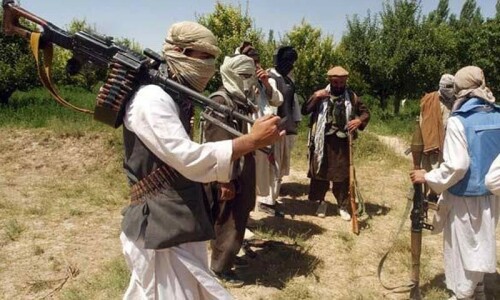
With regard to militancy, as the UN report highlights, the global community must keep its eyes and ears open. For example, the report says that the banned TTP has become the largest terrorist group in Afghanistan, and has developed a working relationship with Al Qaeda. Moreover, endorsing what Pakistan has been saying for a while, the report points out that the Taliban rulers are “unable or unwilling” to tackle the TTP threat.
As per the UN, the TTP conducted over 1,200 attacks against Pakistan last year. But it is not anti-Pakistan militants alone that are using Afghanistan as a base. The anti-China ETIM group, Al Qaeda, as well as IS-K, which threatens Iran, the Central Asian states and Pakistan, are all using Afghanistan as a “permissive haven”. This requires a coordinated response from the international community, particularly Afghanistan’s neighbours, as they are most at risk from terrorist groups.
The Taliban should be told that they need to take action against ‘good’ militants who support them (TTP, Al Qaeda), as well as ‘bad’ militants who oppose them (IS-K). On this, there can be no compromise, and foreign states must emphasise that diplomatic recognition and trade relations all depend on greater counterterrorism efforts.
Published in Dawn, July 15th, 2024