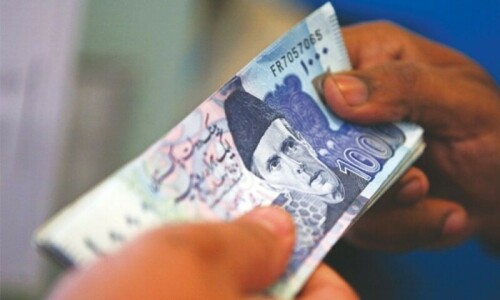
KARACHI: Bank advances to the private sector were only Rs123.8 billion, much less than the record lending of Rs7.7 trillion to the government in the outgoing 2023-24.
The fiscal year, which ends on June 30, witnessed record inflation and an unprecedented interest rate. This kept the private sector out of costly banking money, resulting in poor economic growth of 2.3 per cent for FY24.
The economy contracted in FY23, as evidenced by the low borrowing of just Rs208.2bn throughout the fiscal year.
The State Bank of Pakistan data showed that the private sector could borrow Rs123.8bn from July 1 to June 14, 2023-24, compared to Rs62.3bn in the same period of last fiscal year. However, at the end of FY23, the borrowing reached Rs208.2bn.
Govt borrowing at Rs7.7tr is 62 times more than private sector’s Rs124bn
Bankers said the jump came due to the closure of the fiscal year, as most of the payments are cleared to start with the new year.
“This Rs123.8bn is not final as borrowing made in the last 16 days of the month has yet not been reported, but it is open that most of the borrowing was made for short-term working capital,” said a senior banker.
During the current fiscal year, Islamic banks remained extremely cautious, and lending to the private sector fell sharply from Rs408.8bn in FY23 to just Rs75.7bn.
Conventional banks’ lending to private clients also fell but remained at Rs35.5bn, down from Rs87.3bn in the same period last year.
The Islamic branches of conventional banks changed the trend this year.
In FY23, they did not lend to the private sector; instead, they recorded a net debt retirement of Rs433.7bn last year.
Despite very low lending to Rs12.6bn in FY24, the Islamic branches of conventional banks returned to the positive side.
Banking experts said both Islamic banks and Islamic branches of conventional banks found much better opportunities to invest in government papers to earn risk-free, easy money. The government’s borrowing from banks in FY24 exceeded the combined borrowing of FY23 and FY22.
Banks’ profitability doubled in calendar 2023, but the economy had to pay the price. The shrinking economy failed to create jobs; instead, more people got poorer. Thanks to persistent political instability, at least 40pc of Pakistanis live below the poverty line.
No independent economists in Pakistan supported the tax-laden budget 2024-25 and criticised the government for multiplying the general public’s economic and financial woes.
“The State Bank has reduced the policy rate by 1.5pc 20.5pc, which is still very high. “If the economy does not work, how can the government generate 40pc more revenue in the next fiscal year?” asked Amir Aziz, an exporter and manufacturer of textile products.
He said a drastic cut in the interest rate is needed to stimulate the economy and generate jobs for millions of jobless Pakistanis.
Published in Dawn, June 30th, 2024