0
0

ONE of the world’s biggest cities, Karachi is right now battling with the consequences of unplanned urbanisation. Enormous housing schemes serve as an example of this expansion. Such projects have raised questions about the negative impact on the environment. Construction on a massive scale has also had a negative impact on indigenous wildlife. The International Union for Conservation of Nature (IUCN) estimates that the diversity of bird species has declined by 30 per cent in Pakistan’s urbanised regions.
According to the Climate Risk and Adaptation in South Asia report by the World Bank, Karachi’s per capita water accessibility diminished from 1,400 cubic meters in 1947 to a meagre 100 cubic meters in 2014. Just imagine what it would be like today after all the housing schemes that have cropped up in the last 10 years.
A supply shortage of more than 500 million gallons per day is reported by the Karachi Water and Sewerage Corporation (KWSC). Besides, Karachi generates more than 12,000 tonnes of solid waste per day, according to the Sindh Solid Waste Management Board.
Due to the inability of the current waste management infrastructure to keep up, landfills are flooding, polluting the environment.
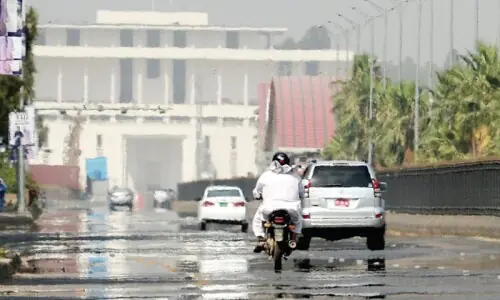
The urban warm island impact raises the average temperature in cities, as urbanisation leads to a decrease in vegetation and an increase in concrete areas.
According to research conducted by the Pakistan Environmental Protection Agency, fewer green spaces have hugely contributed to average temperature increase of two degrees Celsius in Karachi over the last 20 years.
Loss of indigenous wildlife, green spaces, and water assets, along with the warm island impact, are critical issues that we need to combat. Large-scale advance-ments are essential to accommodate Karachi’s burgeoning population, but sustainable practices should take priority over everything else. Moving forward, environmental impact assessments should be required for all projects. Apart from green spaces, rainwater harvesting systems, and encouraging water-efficient technologies are essential steps.
Additional research can probe specific areas of concern and investigate potential mitigation strategies. To ensure a healthy environment in Karachi for future generations, the authorities need to implement sustainable development practices today; earlier, the better.
Muhammad Waqas
Karachi
Published in Dawn, June 11th, 2024