Gaza to dominate sessions as WEF summit kicks off


RIYADH: The situation in Gaza and broader Middle East tensions are expected to get top billing at a Saudi-hosted special meeting of the World Economic Forum (WEF) that began here on Sunday.
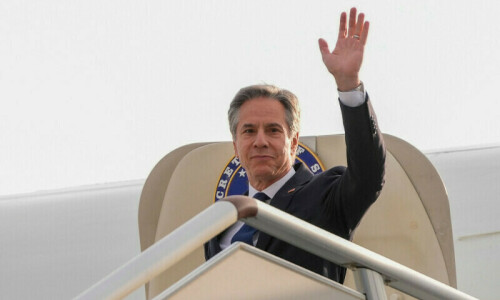
US Secretary of State Antony Blinken, Palestinian leaders and high-ranking officials from other countries striving for a ceasefire are on the guest list for the summit in the capital of the world’s biggest crude oil exporter.
Saudi Arabia called for regional “stability”, warning of the effects of the ongoing attacks in Gaza on global economic sentiment at the start of a summit, attended by a host of Gaza mediators.
The Gaza situation along with conflicts in Ukraine and elsewhere put “a lot of pressure” on the economic “mood”, Saudi Finance Minister Mohammed al-Jadaan said at one of the first panel discussions of the two-day WEF special meeting.
Saudi Arabia calls for regional stability; minister cautions world walking tightrope trying to balance security and prosperity
“I think cool-headed countries and leaders and people need to prevail,” he said. “The region needs stability.”
Earlier, Saudi planning minister Faisal al-Ibrahim told a presser the world was “walking a tightrope right now, trying to balance security and prosperity.” He said, “We meet at a moment when one mis-judgement or one miscalculation or one miscommunication will further exacerbate our challenges.”
WEF President Borge Brende said there was “some new momentum now in the talks” around the prisoners, and also for… a possible “way out of the impasse we are faced with in Gaza”. However, there will be no Israeli participation at the summit and Brende noted that formal mediation involving Qatar and Egypt was unfolding elsewhere. “This is more an opportunity to have structured discussions” with “the key players”, he said.
“There will be discussions, of course, on the ongoing humanitarian situation in Gaza” as well as on Iran that supports Hamas and Hezbollah, he added. The gathering “has all the prospects for becoming a very consequential meeting.”
The US State Department said that Blinken would discuss ongoing efforts to achieve a ceasefire in Gaza that secures the release of prisoners.
Over the past seven months, over 34,388 Palestinians, mostly women and children, and 1,170 Israelis have been killed in Gaza, according to the Palestinian and Israeli sources. Both sides have also held many prisoners.
From the outset, Saudi Arabia has worked with other regional and global powers to try to contain the attacks in Gaza and avoid the type of conflagration that could derail its ambitious economic reform agenda known as Vision 2030.
Spotlight on Saudi Arabia
The kingdom also remains in talks about a landmark deal under which it would recognise Israel for the first time while strengthening its security partnership with the United States.
Crown Prince Mohammed bin Salman, Saudi Arabia’s de facto ruler, spoke optimistically about the deal in an interview with Fox News in September, but analysts say the Gaza situation has made it more difficult.
Yet questions persist about just how much of Vision 2030 will be achieved and when, with special scrutiny falling on signature projects such as NEOM, a planned futuristic megacity.
In December, Finance Minister Mohammed al-Jadaan said officials had decided to push the timeframe for some major projects past 2030, without specifying which ones. “Certain projects can be expanded for three years — so it’s 2033 — some will be expanded to 2035, some will be expanded even beyond that and some will be rationalised,” he said.
Published in Dawn, April 29th, 2024