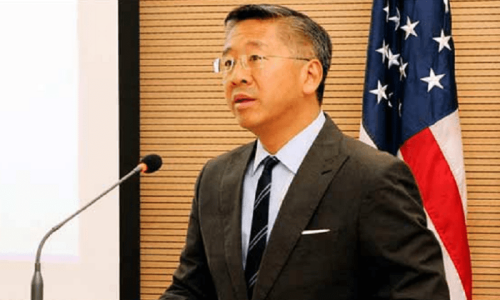
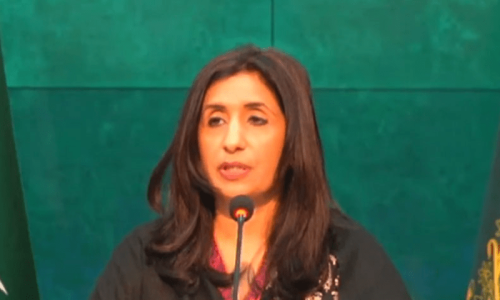
WASHINGTON: The Foreign Affairs subcommittee hearing that featured a testimony from Donald Lu elicited mixed reactions from US-based experts.
While supporters of the PTI seemed unhappy with his categorical rejection of the charges, they saw a tacit confirmation of the existence of a regime change threat, in his words before the US House.
However, others quickly seized on Mr Lu’s rejection of the PTI conspiracy narrative, with Shuja Nawaz, a Pakistani-American scholar associated with the Atlantic Council, saying: “The Lu conspiracy theory was a reflection on poor decision-making in the upper echelons of the Pakistani government.”
“It targeted a US diplomat who was known for being empathetic to Pakistani needs and actively supported economic aid from international financial institutions,” he told Dawn.
Scholars offer mixed reactions on hearing’s importance in larger context of US-Pakistan ties
Mr Nawaz argued that Wednesday’s hearing exposed Pakistan’s reliance on US support and trade dependence.
He noted that the hearing occurred shortly after the IMF staff agreement for the potential release of $1.1 billion — a much-needed relief for Pakistan’s struggling economy.
Analysing the US response to allegations of election irregularities in Pakistan, Mr Nawaz pointed out that US lawmakers at the hearing failed to pursue examples of comparable visa sanctions on Bangladesh and other countries where the US had determined that election irregularities had occurred.
He also urged the government to allow the Election Commission of Pakistan to “re-run” some seats where egregious finagling of results was identified. “Otherwise, the risk of future US sanctions will remain,” he warned.
Uzair Younus, another Atlantic Council scholar of Pakistani origin, remarked that the hearing was a departure from past proceedings, which often descended into outright criticism of Pakistan regarding the war in Afghanistan.
“It was evident that both Congress and the State Department are eager to have a bilateral relationship with Pakistan that stands on its own merits,” he said.
Mr Younus noted that US lawmakers also raised other critical issues during the hearing, such as the proposed construction of a gas pipeline from Iran, growing terrorism in Pakistan, and the role of Chinese lending in Pakistan’s economic crisis.
“Finally, both Congress and the State Department agree that a more democratic Pakistan governed by the letter and spirit of its constitution is critical to a stronger relationship with the United States,” he said.
It became evident during the hearing that US lawmakers were aware of the election rigging and were seeking a remedy but were cautious not to exert excessive pressure on Pakistan, fearing it could further align the country with China.
However, Michael Kugelman of the Wilson Centre in Washington seemed nonplussed by the testimony. “We got a more detailed idea of what US policy toward Pakistan looks like from the most senior US official focused on Pakistan at [the State Department].”
Otherwise, this was a routine Congressional hearing on a topic of relatively “little import to broader US policy-and yet the room was packed with people, some of them quite rowdy,” he said.
Plots against Sikhs
Mr Lu also informed the panel that the United States was collaborating with the Indian government to hold accountable those behind a plot to kill Sikh Gurpatwant Singh Pannun on American soil.
An Indian national, Nikhil Gupta, was charged by federal prosecutors in November last year in connection with his involvement in a foiled plot to assassinate Pannun, who holds dual citizenship of the US and Canada.
“This is a serious issue. A serious issue between the United States and India,” Mr Lu told the panel.
“We take this in the administration incredibly seriously and have raised it at the highest levels with India.”
US officials, he said, were working with India to encourage New Delhi to hold accountable those responsible for this terrible crime.
Mr Lu was responding to a question from Congressman Dean Phillips from Minnesota, who asked if sanctions similar to those placed on more than 500 individuals relating to the killing of Alexei Navalny in Russia can be slapped on India as well.
Published in Dawn, March 22nd, 2024