IT is the misfortune of Pakistan’s more than 240m citizens that their political leadership simply refuses to learn. The country again stands at a crossroads — but for once, the overwhelming majority seems to be in agreement on what the source of its political instability really is.
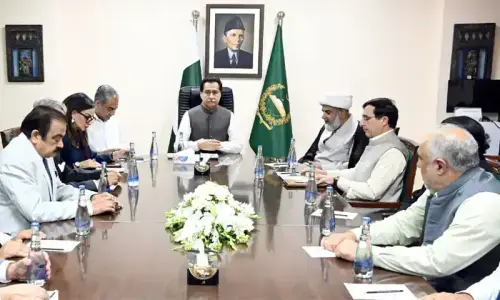
Even the parties which have been co-opted by the establishment today are uneasy, knowing well they may find themselves on the receiving end before long. One would expect that this realisation would compel popular politicians — those whose fortunes’ rise and fall are tied to the health of Pakistan’s democracy — to work together and find a path forward that guarantees their preservation.
Instead, what we see is the heads of ‘democratic’ parties quibbling over who ought to be more favoured by those who have for long sought to go beyond their mandate. Therein lies the tragedy of Pakistan’s dream of ‘civilian supremacy’ — its biggest champions are usually the first to betray it.
The recent general election has greatly complicated the situation. It would have been much easier for our political stakeholders had they heeded what this publication and many others had repeatedly urged them to do well before the polls: sit down, find common grounds, and talk.
Instead, our political parties collectively failed to make any sincere effort to that end. Those who were in the state’s ‘good books’ thought they would get their legitimacy from the polls, while the PTI believed the democratic system, which it had helped weaken with its own hands, would ultimately save it. Neither got what they had depended on.
Though the people of Pakistan managed to deny the powerful what they wanted, the powerful also managed to deny the people the outcome they wanted. We are, therefore, once again at a stalemate. It would be delusional to call it anything else.
Where do we go now? There is talk of reconciliation, but how can it be achieved when one side believes it has the right to power but not the means to exercise it, and the other has the power but knows it has not earned the right to exercise it?
This conflict cannot be easily reconciled, especially with those supposed to act as arbiters uninterested in getting involved. However, what other choices do our leaders have? Revolutions are unpredictable; politics is the art of the possible.
Without compromise, our politicians cannot achieve what they want. It is time they realised that the problem is not their rivalry but the fact that none of them is free as long as they continue to depend on non-political forces to get involved. The country has been bitterly divided by their refusal to acknowledge this simple truth: they owe it one sincere effort to get along.
Published in Dawn, March 9th, 2024