WTO talks end with no major win



ABU DHABI: A high-level WTO conference ended on Saturday with a temporary extension of an e-commerce moratorium but no deals on agriculture and fisheries, throwing into doubt the effectiveness of the multilateral trade body.
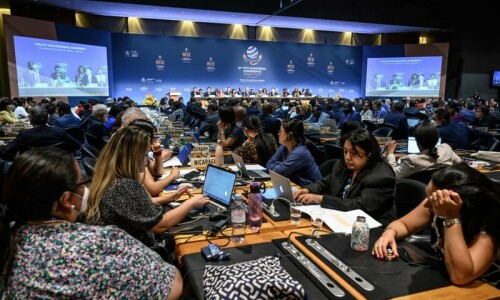
The outcomes of the World Trade Organisation’s 13th ministerial conference in Abu Dhabi highlighted the sharp divisions between the body’s 164 members amid geopolitical tensions and economic headwinds that are threatening global commerce.
“The WTO needed a good crisis and perhaps this will lead to a realisation that we cannot continue like this,” said a senior European Union official participating in the talks.
Speaking at the closing press conference, the Emirati chair of the so-called MC13 gathering, Thani Al Zeyoudi, acknowledged the shortcomings.
“Despite our best efforts, we failed to agree on some texts which are of great importance to many of our members,” said Al Zeyoudi, who also serves as the UAE’s foreign trade minister.
For her part, WTO Director-General Ngozi Okonjo-Iweala said the talks came up “against an international backdrop marked by greater uncertainty than at any time I can remember”.
“We have achieved some important things and we have not managed to complete others,” she said while insisting that the “glass was half full”.
The WTO, the only international body dealing with the rules of trade between nations, requires full consensus from all members to chalk up deals.
It was hoping the MC13 would replicate the landmark success of its 2022 ministerial in Geneva, which yielded a deal on fisheries and saw members agree to restore a now-defunct dispute settlement system by the end of this year.
But the latest ministerial fell short of that objective.
“The unexpected weakness of the overall (MC13) package should... serve as a wake-up call,” the secretary general of the International Chamber of Commerce, John Denton, said in a statement.
‘Bogged down’
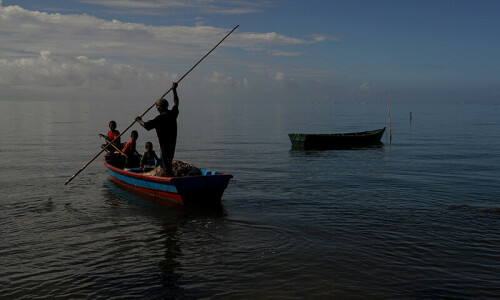
After a 2022 deal that banned subsidies contributing to illegal, undeclared and unregulated fishing, the WTO was hoping to conclude a second package focusing on subsidies that result in overcapacity and overfishing.
Negotiations in recent months at the WTO headquarters in Geneva had enabled a draft text to be brought forward for a second fisheries deal, which provided flexibility and advantages for developing countries.
But some — notably India — demanded further concessions, including transition periods that others consider to be too long. At MC13, a revised draft fisheries agreement faced strong objections from New Delhi.
“There was basically just one country that was blocking the deal,” said EU trade commissioner Valdis Dombrovskis, without specifying which member.
Richard Ouellet of Canada’s University of Laval said “consensus, which was once the cement of this organisation, has now become the mud in which it is bogged down”.
Emirati sway
With farmer protests sweeping Europe and India, agriculture agreements also emerged as a particularly sensitive topic of debate.
Member states were trying to negotiate a text listing the subjects that merit further discussion.
An agriculture package, however, was hampered by a firm demand by India for permanent rules governing public stockholding of food reserves to replace temporary measures adopted by the WTO. India’s insistence on a permanent solution for public stockholding was “impossible to bridge”, Dombrovskis said.
Despite failing on agriculture and fisheries, the WTO managed to temporarily salvage a moratorium on customs duties for digital transmissions that was extended for another two years.
It faced a particularly strong challenge at MC13, with countries led by India and South Africa arguing that it harms customs revenues.
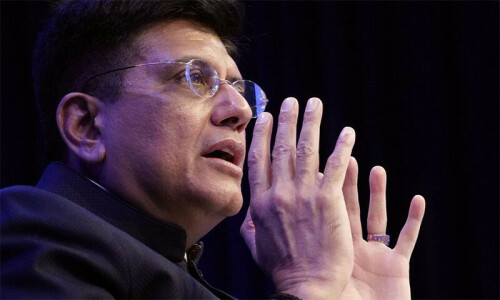
India’s Commerce Minister Piyush Goyal said on Friday that he allowed the extension to pass “out of respect” to the conference’s Emirati chair, whom he called a “good friend”.
However, the moratorium, which has been regularly extended since 1998, is set to definitively expire on March 31, 2026, with no chance of an extension, Iweala said. “I think that the membership has agreed... on very firm dates for its conclusion,” she said.
“I have to abide by what the membership has just decided.” On dispute settlement reform, the final outcome mainly reiterated the commitment made at MC12 to have a fully and well-functioning dispute settlement system in place by 2024.
Published in Dawn, March 3rd, 2024