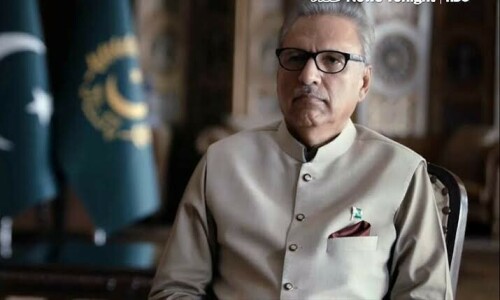
ISLAMABAD: President Arif Alvi continues to draw the ire of political parties over his refusal to summon the National Assembly session as PML-N and PPP leaders warned these actions could lead to “legal consequences”.
On Tuesday, the Prime Minister’s Office (PMO) also rejected the objections raised by President Arif Alvi on the summary to summon the National Assembly session, a source in the PMO told Dawn.
In response to a summary sent by the Parliamentary Affairs Division last week, the president said since the lower house was not complete, he could not summon the session.
The PMO has rejected this objection and states that the Constitution clearly stated that the first NA session should take place within 21 days after the elections and that the president could summon the session before the expiry of the deadline.
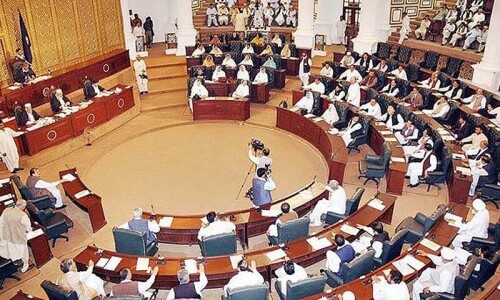
Mr Alvi’s actions are unlikely to hamper the formation of the new government as the National Assembly speaker has summoned the session at 10am on Feb 29.
Bilawal, Dar say action tantamount to ‘abrogating Constitution’; PMO rejects objections on summary
Meanwhile, PPP Chairman Bilawal Bhutto-Zardari has said that several cases will be made against President Alvi for “abrogating the Constitution”.
Legal consequences
While talking to media outside the Supreme Court on Tuesday, Mr Bhutto-Zardari added one case would be filed for dissolving the National Assembly when a no-confidence motion was moved against the then prime minister Imran Khan and the second for abrogating the Constitution by not convening the National Assembly session.
He, however, said his party had no plan to impeach the president.
Responding to a question, the PPP leader said he went into the election with a pledge to form a truth and reconciliation commission and release all political prisoners after coming into power.
“But the nation has not given me the mandate, and now I can only advise for it [the release of political prisoners],” he added.
The PPP leader said his party’s position has always been that the judiciary and establishment should work within their ambit as per the Constitution.
“If politicians want respect from these institutions, they should first start acting within their domains. Only in this way we can avoid incidents like May 9,” he added.
“Otherwise, we cannot expect our judiciary, media or any other institution to stay within their limits.”
On a question about talks with the Sunni Ittehad Council (SIC), which is now home to PTI-backed members, Mr Bhutto-Zardari said he wanted to engage with SIC on government formation.
“They [SIC] did not approach PPP for votes to begin with, so they cannot raise objections over someone else forming the government, as they made no efforts to do so themselves.”
He said it was PTI’s decision not to engage with other parties. “We were then left with the option to engage with the party [PML-N] that approached us,” he said, adding that PPP will provide its input through the parliament.
In a wry remark, he expressed gratitude to SIC and PTI members for “allowing Maryam Nawaz Sharif and Murad Ali Shah to be elected as chief ministers of their respective provinces unopposed”.
“Shehbaz Sharif is now on his way to unanimously being elected as the PM, and the credit goes to the two parties,” he added.
PML-N Leader Ishaq Dar also alleged the president abrogated the Constitution by not summoning the NA session and would face legal cases.
Mr Dar said the caretaker federal government replied to the president’s objections as per law, and if “sense prevailed”, the president would convene the NA session.
He urged the law ministry, National Assembly Secretariat and other departments to summon the session by Thursday as per the Constitution.
The PML-N leader said the chief minister, speaker and deputy speaker of the Balochistan Assembly would be elected with the coalition parties’ support.
Published in Dawn, February 28th, 2024