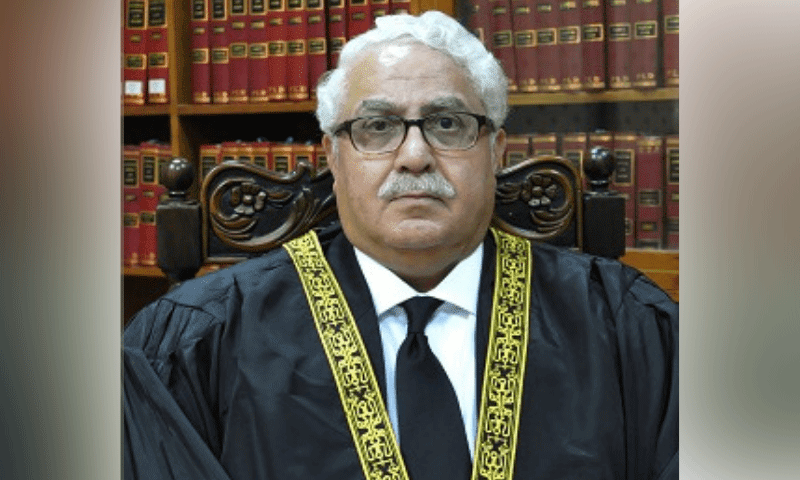
ISLAMABAD: Justice Jamal Khan Mandokhail has stressed the need to decide complaints against judges in the Supreme Judicial Council (SJC) since they can’t be prosecuted under ordinary law.
On Monday, a five-judge bench headed by Justice Aminuddin Khan resumed the hearing of federal government’s Intra-Court Appeal (ICA) challenging the 2023 Afiya Shehrbano Zia verdict.
Justice Mandokhail, a member of the bench, observed that judges enjoyed immunity from being prosecuted under ordinary laws other than the SJC.
If serving judges of the superior court get entangled in cases under common laws like the NAB Ordinance, etc, it will take 20 years to clear their name.
Constitution silent on how to deal with complaints against judges, notes Justice Hilali
Therefore, it is in the judge’s interest that SJC concludes its proceedings even if they have resigned or retired, Justice Mandokhail observed.
The federal government has challenged the 2023 verdict stating that judges who resign or retire cannot be held accountable by the SJC as per Article 209 of the Constitution.
The appeal pleaded that the council had virtually become redundant after the verdict.
Justice Musarrat Hilali observed that the Constitution protects the judge, who resigned before the completion, from prosecution since no procedure has been spelt out on how to deal with this situation.
Two of the amici appointed by the bench for assistance in the case also supported the proceedings against former judges.
Abdul Moiz Jafferii argued that only SJC could determine whether a judge is guilty of professional misconduct like corruption, dereliction of duty, or violation of oath, even if they retire. The issues come under the purview of SJC regardless of the fact that judges are in the office or not, said Mr Jafferii.
If judges were hounded by NAB, FIA or other authorities after they stepped down, it would adversely affect their ability to decide cases since they would be under the impression of being answerable for every action he has taken as a judge.
Mr Jafferii argued that SJC proceedings were the filter to first determine, by their independent peers, whether the judge has been guilty of misconduct or not.
Only after the first filter is satisfied, the normal laws can be applied against the judges. Therefore, SJC should continue its proceedings even if the judge retires, Mr Jafferii concluded.
Another amicus curiae, Muhammad Akram Sheikh, argued that if the judge facing proceedings before SJC was allowed to resign, it would be tantamount to a gun in the judge’s hands to shoot the council the moment they feel the scales tilting against them.
The senior counsel cited precedence from the US states of North Carolina and New Hampshire, adding that after the resignation or retirement of judges, SJC proceedings do not stand abated.
It is not like a light bulb that can be switched on or off, and once SJC assumes jurisdiction on a complaint against the judge on misconduct, then it should conclude the proceedings, argued Mr Sheikh.
Faisal Siddiqui, one of the amici, argued that the ICA was not maintainable and explained that it was wrong to presume that Article 209 provides immunity to judges if they resign before the SJC completes its inquiry.
The presumption that judges prefer to resign only to escape proceedings and thus be given a clean chit is wrong since, even after the resignation, they can be prosecuted under normal laws, the senior counsel contended.
The council emphasised that the jurisdiction of Article 209 was limited only to serving judges and didn’t apply to a judge after they tender resignation.
Mr Siddiqui reasoned that as per the procedure, if an SJC finds a sitting judge guilty of misconduct, it can recommend the president to remove the said judge from office. But if the judge has already quit, then what would the SJC recommend?
Therefore, the council has no role after the resignation or retirement of a judge.
Published in Dawn, February 20th, 2024