Rafah incursion will affect prisoner swap talks, Hamas warns

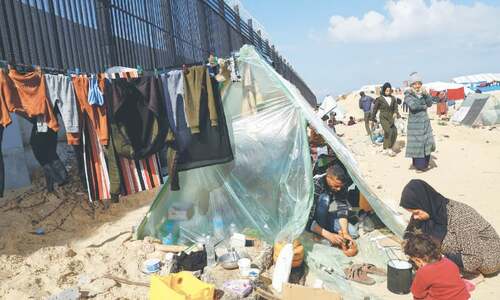
GAZA STRIP: The threat of an Israeli incursion into Gaza’s southernmost town of Rafah persisted on Sunday, but Hamas warned Tel Aviv that such an offensive into the city, crowded with displaced Palestinians, would threaten talks about the release of prisoners.
Though Israeli Prime Minister Benjamin Netanyahu promised “safe passage” to civilians displaced in Rafah, a leader in the Palestinian group told AFP, “Any attack by the occupation army on the city of Rafah would undermine the exchange negotiations”.
In an interview, Mr Netanyahu reiterated his intention to extend Israel’s military operation against Hamas into Rafah.
Despite international alarm over the potential for carnage in a place crammed with more than half of the Gaza Strip’s 2.4 million people, he told ABC News: “We’re going to do it”.
IMF says conflict is ‘devastating’ Palestinian economy; over 90 killed in overnight attacks
“We’re going to do it while providing safe passage for the civilian population so they can leave,” he said.
Mr Netanyahu’s announcement set off a chorus of concern from world leaders.
“The people in Gaza cannot disappear into thin air,” German Foreign Minister Annalena Baerbock wrote on social media platform X, adding that an Israeli offensive on Rafah would be a “humanitarian catastrophe in the making.”
Saudi Arabia’s foreign ministry warned on Saturday of “very serious repercussions of storming and targeting” Rafah and called for an urgent UN Security Council meeting, while UK Foreign Secretary David Cameron said he is “deeply concerned” about the prospective offensive.
“The priority must be an immediate pause in the fighting to get aid in and hostages out,” he wrote.
The US State Department warned that if not properly planned, such an operation risks “disaster”.
The office of Palestinian president Mahmud Abbas said the move “threatens security and peace in the region and the world” and is “a blatant violation of all red lines”.
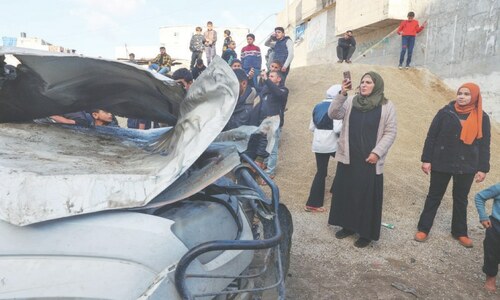
The Hamas-run territory’s health ministry said on Sunday that 94 people were killed in overnight bombardments across Gaza, including in Rafah.
The Israeli military said it killed two “senior Hamas operatives” in a strike on Rafah Saturday.
It was part of a wider bombardment that killed at least 25 people in the city, according to the Hamas-run health ministry.
Palestinian economy
Meanwhile, the International Monetary Fund’s chief said that the conflict had devastated the economies of both the embattled Gaza Strip and the occupied West Bank, adding that only “durable peace” would improve the outlook.
“The Palestinian economy’s dire outlook is worsening as the conflict persists,” managing director Kristalina Georgieva told the World Governments Summit in Dubai.
“Only a durable peace and political solution will fundamentally change it”.
“Economically, the impact of the conflict has been devastating,” Ms Georgieva said.
In the war-ravaged coastal territory, economic activity dropped 80 per cent from October through December compared with a year earlier, the IMF chief said.
In the West Bank, the drop was 22pc, she added.
The larger Palestinian territory has been hit hard by Israel’s withdrawal of 130,000 work permits, the proliferation of checkpoints that has heavily disrupted transportation, the loss of tourism, being cut off from Gaza and Israel’s withholding of tax revenues from the Palestinian Authority.
The unprecedented attack by Hamas in October resulted in the deaths of about 1,160 people. Israel vowed to destroy the group and launched air strikes and a ground offensive that have killed at least 28,176 people, mostly women and children, according to the health ministry in the Hamas-run territory.
Beyond the Palestinian territories, the conflict has also hit the tourism sectors of neighbouring countries such as Egypt and Lebanon, the IMF chief said.
Meanwhile, attacks on commercial shipping by Yemen’s Houthi rebels, which the group says are in solidarity with Palestinians in Gaza, are leading to “rising freight costs and reduced Red Sea transit volumes (which are) down by nearly 50 per cent this year in our PortWatch data,” Ms Georgieva said.
Published in Dawn, February 12th, 2024