New govt to ink loan accord with China for ML-1



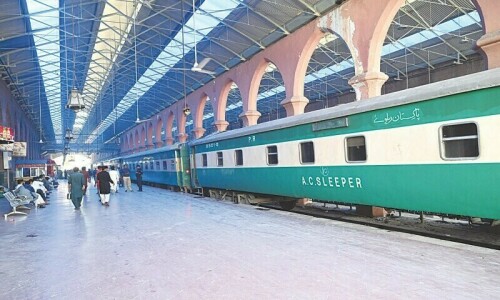
LAHORE: The terms on conditions related to the loan pledged by Beijing for the Pakistan Railways’ flagship project — Main Line-1 (ML-1) — will be finalised by the upcoming government with the Chinese authorities.
“Everything, except finalisation of the terms and conditions related to financing/loan by the government, has been completed, as no issue about the project exists at the moment on the part of Pakistan Railways (PR), federal government or the Chinese government,” the PR’s Chief Executive Officer Amir Ali Baloch told Dawn on Saturday.
“It will be a government-to-government (G to G) discussion wherein the new government will sign the loan agreement after finalising the financing terms and conditions such as interest rate, repayment period etc,” Mr Baloch responded while responding to a query raised by Dawn.
“All things, except the signing of the loan agreement, have been settled already. Even an addendum on the agreed cost of the project has also been signed,” he added.
It may be mentioned that ML-1 project will be executed under China-Pakistan Economic Corridor (CPEC). Both the countries had also signed an addendum to the CPEC’s framework agreement under which the ML-1, the country’s first-ever state-of-the-art mega project, will be executed with a rationalised cost of $6.678 billion instead of $9.85bn. The addendum related to the revised ML-1 project had been signed by the representatives of the two countries on the sidelines of the Belt & Road Initiative (BRI) forum held on Oct 17 and 18, 2023. The caretaker premier Anwaarul Haq Kakar had attended the meeting.
With the revised cost, the project’s title is now “Rationalised Upgradation of Ml-1 at 140/120km per hour (Upgradable to 160km per hour)” instead of the previous one “Upgradation of Ml-1 at 160/120 km per hour” as per approved PC-I.
Under the revised plan, the project consists of three phases having a total length of 1,726km. Phase-1, 2, 3 and 4 comprise Karachi-Multan, Multan-Lahore, Lahore-Lalamusa and Lalamusa-Peshawar. The design speed would be up to 140km per hour which can be increased to 160km per hour on the upgraded track once the entire left/right of the track is fenced and some other upgrade work is done completely.
Talking about the PR’s train modernising initiative, Mr Baloch said the department’s state-of-the-art restaurant on-wheel project is also being extended to three express trains in the next couple of months.
Published in Dawn, February 11th, 2024