KABUL: While most of the world treats Afghanistan’s Taliban government as a pariah, China is growing diplomatic and economic links — and Kabul is happy for the attention.
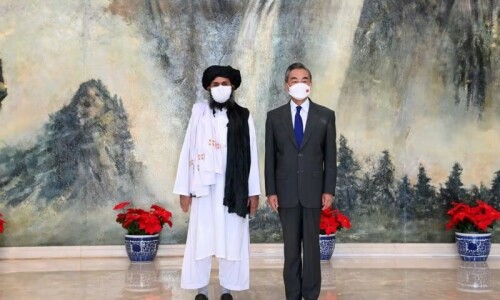
Top-level meetings between officials, new mineral deals, and the upgrading of transport routes between the two countries are regularly championed by Taliban government officials.
While Beijing has played down the formality of these growing links, it is steadily increasing investment and exposure — a relationship that could benefit both parties, analysts and diplomats say.
“The Islamic Emirate of Afghanistan is a challenging terrain, but the characteristic of the Chinese is to go where no one else goes, trying to gain advantages,” said Valerie Niquet, an analyst with the Foundation for Strategic Research in Paris.
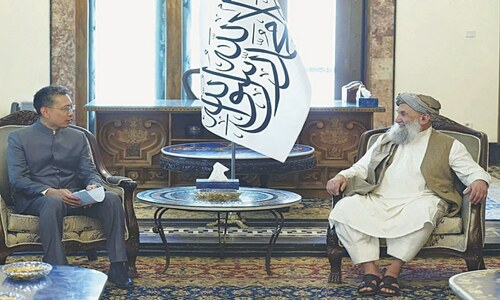
“The Chinese are extending a hand to the Afghans, who need all possible assistance.” In September China became the first country to appoint a new ambassador to Kabul, and on Tuesday the Taliban government’s envoy to Beijing — along with dozens of other diplomats — presented his credentials to Chinese President Xi Jinping.
“I believe that when the concerns of all parties will be more vigorously addressed, diplomatic recognition of the Afghan government will follow naturally,” said Wang Wenbin, China’s foreign ministry spokesman.
Last month China joined Russia in abstaining on a UN Security Council vote calling for the appointment of a special envoy to Afghanistan — something strongly opposed by the Taliban authorities.
The expectations of the international community include allowing girls and women to be educated, letting them to work, introducing a more inclusive government, and greater protection for minorities.
But China’s approach — exchanging ambassadors without official recognition — allows Beijing to maintain relations while also not breaking ranks with the rest of the world. “Fundamentally, China doesn’t care about women’s rights; if its interest is to get closer to the Taliban regime, it won’t impose conditions,” Niquet said.
In turn, Taliban authorities have said nothing about the alleged mistreatment and rights abuses suffered by Muslim Uyghurs in China’s Xinjiang region bordering Afghanistan.
Natural resources
The prize in all this is access to Afghanistan’s wealth of untapped mineral resources — as well as a market for Chinese goods. “The vast natural resources of Afghanistan, such as copper, lithium, or rare earths, have significant economic potential for China,” said Jalal Bazwan, assistant professor of political science at Kardan University in Kabul.
Immediately after his installation in December as Afghanistan’s ambassador to Beijing, Bilal Karimi held discussions with the Chinese state-owned company MCC on Mes Aynak, the world’s second-largest copper deposit, some 40 kilometres from the capital Kabul.
MCC obtained exploitation rights in 2008 — worth some $3.5 billion — but the project was paralysed by war and insecurity.
Published in Dawn, February 1st, 2024