Challenging times



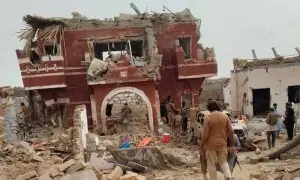
THE year 2024 could not have started on a worse note. First, a humanitarian catastrophe of genocidal proportions has been unfolding in Gaza for over three months, owing to daily attacks by Israel’s defence forces. The Houthis are attacking merchant ships in the Red Sea, obliging the US and other countries to mobilise their navies. Israeli attacks on Lebanon and Syria carry the risk of the conflict engulfing the entire region.
Second, the war in Ukraine has devastated the country, once known for its fertile land and grain exports. Millions of Ukrainians have been displaced, with little access to food, water or electricity. Russia, too, has suffered losses, but remains determined to fight on despite economic sanctions and Nato’s continued expansion eastward. Finland’s inclusion as its 31st member has more than doubled the length of Nato’s borders with Russia. Sweden, too, is gearing up to join. The war’s end is not in sight.
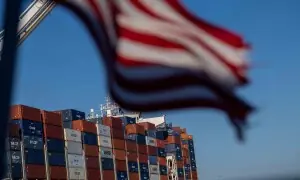
Third, the US-China strategic competition is intensifying, deepening risk and uncertainty in a world already in disorder. The two countries remain locked in a technology war, with growing rivalry over AI supremacy and the manufacture of advanced semiconductor chips that power AI technologies. The US, which has an edge in semiconductors supply chains, is building up additional pressure on China through export controls and investment curbs. For its part, China retains dominance in supply chains for minerals, particularly cobalt and lithium used for manufacturing EVs, batteries and solar panels. To neutralise these advantages, the US has imposed a high tariff on Chinese cars and other products. The rivalry has created alarm that the world is headed towards camp politics.
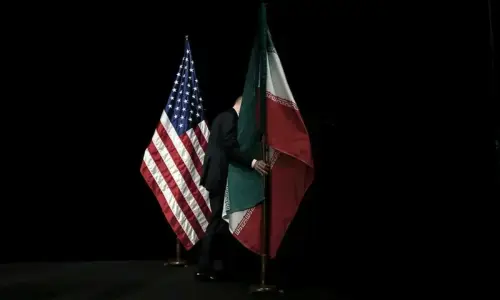
Fourth, the international security environment has been vitiated. Major powers are modernising their nuclear arsenals as arms control regimes give way to a nuclear arms race. In November, Russia de-ratified the CTBT, opening the door for further nuclear testing. The Iran nuclear deal remains in a state of stalemate. The US-Russia agreement, New START, which limits the number of deployed strategic nuclear warheads, was suspended by Russia in 2023. The INF treaty, which sought elimination of intermediate-range nuclear forces deemed essential for European security, was terminated by the US in 2019.
For Pakistan, 2024 is a watershed year.
In the midst of all this, dozens of countries are heading towards elections in 2024. Anxiety surrounds the forthcoming presidential election in the US. Joe Biden, 81, and Donald Trump, 77, are up for a contest the outcome of which would have profound implications for geopolitics, particularly the transatlantic equation. Russian President Vladimir Putin is seeking a fifth term in March. Indonesia and India are going to polls in February and May respectively. The UK will hold elections in the second half of the year. Acrimonious and populist rhetoric is sharpening societal polarisation in countries undergoing electoral transitions. The world economy has picked up pace, and the business use of generative AI has grown manifold. But most developing countries continue to suffer low growth, high inflation and unemployment challenges.
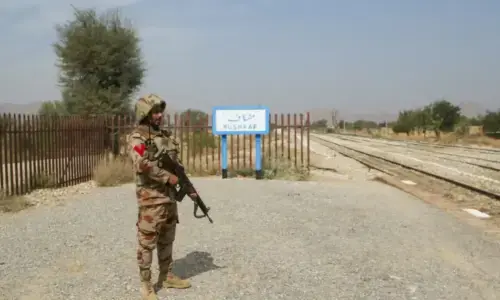
For Pakistan, 2024 is a watershed moment. For years, it has remained in the grip of political instability, economic uncertainty and rising terrorism. The pre-election environment is toxic. The blame game is at its peak. Investors are worried about Pakistan’s economic future. The balance-of-payment crisis is not resolved. In this background, the Feb 8 polls are crucial. Pakistan needs a sustained period of political stability, which would ensure continuity in economic policies and help restore growth and industrial development.
In foreign policy, the next elected government has to manage ties with China and the US, despite their growing rivalry. One piece of good news is that the economies of both countries are so inter-dependent that the decoupling from China’s economy the US had earlier envisaged is not happening. That opens up possibilities for Pakistan to maintain ties with both China and the US. In an age of rising unilateralism and declining multilateralism, countries like Pakistan need to engage in multi-alignments to promote their political, economic and security interests. Pakistan also needs to stabilise its frontiers with Afghanistan and Iran, shifting the focus to economic cooperation.
The trajectory of Pakistan’s ties with India will be determined by the outcome of India’s elections. With the scare created in India against Muslim icons, especially historical mosques, and the tendency of Indian intelligence to target opponents on foreign soil — Canada, the US, and now Pakistan — the new government will need much effort and smart diplomacy to restore normal ties with India.
The writer is a former foreign secretary and chairman of Sanober Institute Islamabad.
Published in Dawn, January 28th, 2024