QUETTA: In the serene village of Koh-i-Sabz in Balochistan’s Panjgur district, a routine sunset transformed into a nightmare on Tuesday.
Residents, accustomed to the peaceful lull of the evening, were startled when they saw a few objects tear through the sky. A deafening explosion followed, leading to a horrifying scene: a massive fire engulfing a house and a nearby mosque.
It was later discovered that the semi-mud house — the residence of Karim Dad, alias Idrees — had been hit by an Iranian missile.
The strike claimed the lives of Mr Dad’s two children — six-year-old Humeira and 11-month-old Suleiman — and injured his wife and three daughters.
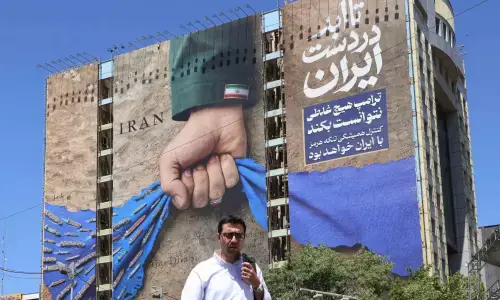
Tehran claimed that it had launched the missiles to target two bases of the militant group Jaish al-Adl. Pakistan condemned the “blatant breach” of its sovereignty and recalled its ambassador from Iran on Wednesday.
The Iranian strike led to panic in the small village. Sources said blasts were also heard in other areas of Koh-i-Sabz, but no casualties or damage was immediately reported. Officials said the mosque near Mr Dad’s house suffered significant damage from missile splinters.
Saeed Ahmed Umrani, the commissioner of Makran division, confirmed the loss of human lives and property damage. “All the four injured have been shifted to the district hospital in Panjgur for urgent care,” he said.
Senior security officials arrived in the affected area following the attack, surveying the damage and speaking with local residents and officials. Levies officials deployed in the area briefed the officials about the attack and the prevailing situation after the strikes.
Helicopters were seen hovering over the area, but they did not land anywhere, possibly due to bad weather.
The Iranian offensive wasn’t limited to missiles. “Not only missiles but also mortar shells were fired from the Iranian side which exploded in different places,” a senior government officer in Makran told Dawn.
He said security measures were immediately beefed up along the border, with additional Frontier Corps troops deployed and put on high alert.
Residents close to the border said that drones were seen flying on the Iranian side, but no fresh attack or space violation was reported from any area.
Balochistan Information Minister Jan Achakzai on Wednesday strongly condemned the Iranian missile attack and violation of Pakistan’s airspace and described it as an international crime.
Speaking to reporters in Quetta, he questioned the rationale behind targeting innocent lives. “Can anybody accept that these innocents were terrorists or members of any terrorist organisation?” Mr Achakzai wondered.
The minister said this “illegal act” of the Iranian government developed serious differences between the two brotherly countries.
He also highlighted the stark contrast between Pakistan’s restraint in the face of border violence and Iran’s aggressive actions. “Aggression by Iran will affect friendly and trade relations between two countries,” he stressed.
To offer some solace, the Balochistan government announced compensation for the families of the deceased and the injured.
Published in Dawn, January 18th, 2024