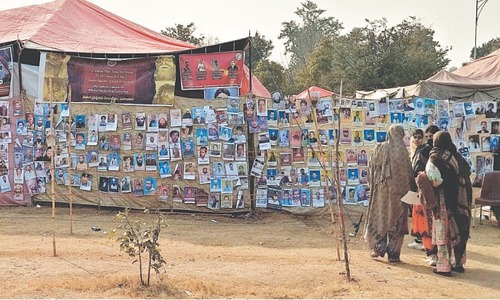
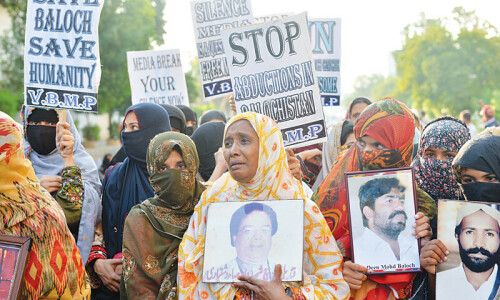
IN recent days, the missing persons’ issue has attracted much back and forth between a group of determined protesters seeking the whereabouts of their disappeared loved ones, and a caretaker government that simply refuses to recognise their anguish as legitimate.
Amidst repeated attempts to gaslight the protesters and paint them as troublemakers, a fresh report submitted by the Commission of Inquiry on Enforced Disappearances gives the lie to the state’s position that it has been unfairly criticised.
In the report, requisitioned by the Supreme Court, the commission has conceded that merely seven per cent of the production orders issued by it have ever been complied with.
Considering that production orders are issued for individuals believed to be in state custody, it is no wonder that the vast majority of victims’ families see the authorities as complicit in the disappearance of their loved ones.
Last week, an Islamabad High Court justice underlined once again that the higher authorities, including the prime minister and his cabinet, are responsible for ensuring the right to liberty of all Pakistani citizens.
He also expressed the hope that the officials directly responsible for disappearing citizens will one day be prosecuted. He made these remarks as protests were roiling Balochistan, where more people have reportedly been disappeared despite the massive spotlight shining on this issue.
Meanwhile in Islamabad, the Baloch Yakjehti Committee, led by Mahrang Baloch, continues to wait on the government in Islamabad, hoping it would make some attempt at rapprochement. Along with other BYC leaders, she remains camped outside the National Press Club, still knocking on the state’s door, still hoping the Baloch will be welcomed in.
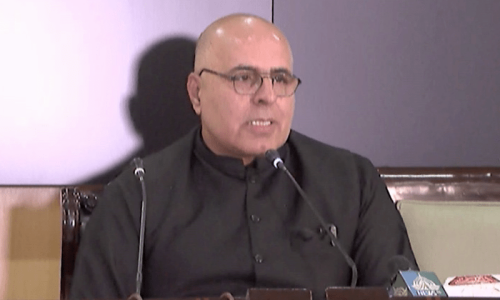
One hopes it won’t be long. From the ‘welcome’ given to these protesters by the Islamabad police, the hurtful remarks made about their ‘duplicity’ by the caretaker prime minister, and a fresh insult from the Balochistan caretaker information minister, who on Wednesday accused the protesters of using their grief to get visas for other countries, the state has made a mess of the situation.
There has recently been a global outcry against the subjugation of historically disadvantaged people, and this seems like a particularly bad time for Pakistan to be presenting itself as a case study. One wonders what the state believes it stands to gain from such tactics.
The country is in turmoil: internal security is weakening, the political arena remains gripped in chaos, the economy is on the ventilator, and too many social groups seem unhappy about the state’s oppressive policies towards them.
Given the breadth of challenges facing the country, those who have assumed responsibility for it must start putting out fires, not stirring up more trouble for future generations.
Published in Dawn, January 15th, 2024