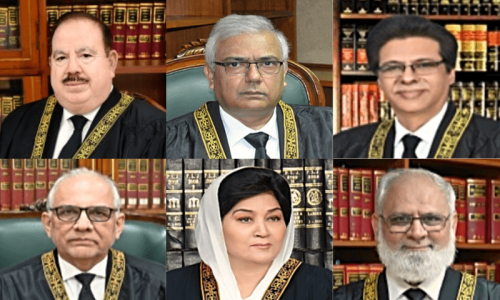
LAHORE: The Human Rights Commission of Pakistan (HRCP) fears that the Supreme Court’s decision to suspend the operation of its earlier short order that had declared the military trial of civilians ‘unconstitutional’ will result in delayed justice to those who deserve to be exonerated from the charges levelled against them.
Moreover, suspending the earlier decision, from a practical perspective, means the denial of bail to all the affected individuals, thereby violating their right to liberty.
In a statement on Friday, the HRCP says the order of the honourable court is deeply worrying from a human rights perspective because it paves the way for continued military trials of civilians which, as the commission has consistently pointed out, violates their right to due process and a fair trial.
The secrecy surrounding military court proceedings, the extremely high conviction rate of these courts and the possible means used to achieve such rates, and the absence of the right of appeal before civilian courts — whose role is restricted to exercising narrow powers of judicial review in such cases — are all reasons for which military jurisdiction over civilians has been globally disapproved.
Continuation of any trial in the light of the Supreme Court’s verdict through a subsequent interim order has allowed an unconstitutional process to proceed in military courts.
It is especially of concern that such an order was passed without there being any element of irreparable harm apprehended from the non-suspension of the apex court’s earlier short order.
The HRCP is compelled to question the prudence of not only the order in question but also hearing of the appeals against the Supreme Court’s verdict before the detailed judgment was announced.
However, it fervently hopes that the concerns arising from the interim order will be addressed through an expeditious and final adjudication by the Supreme Court.
Published in Dawn, December 16th, 2023