ISLAMABAD: The Punjab government has informed the Supreme Court that trials by court martial do not curtail the rights guaranteed by the law.
The chief secretary of Punjab while challenging the apex court’s Oct 23 unanimous decision on Friday also said that such trials do not prejudice or violate [the law], or are contrary to the principles of natural justice, due process of law, and the right to fair trial.
It may be recalled that the Oct 23 judgement had declared the trial of 103 civilians identified in relation to their alleged involvement in the May 9 violence as against the Constitution.
The federal government, defence ministry, the Khyber Pakhtunkhwa and Balochistan governments have already moved similar ICAs before the Supreme Court.
Centre, KP and Balochistan have already filed similar appeals before apex court
Filed through Advocate General Punjab Khalid Ishaq, the appeal emphasised that the court martial merely provides for an efficient judicial structure to entertain offences under the Pakistan Army Act (PAA) 1952 related to security of personnel and establishments of the armed forces.
Several judicial and quasi-judicial forums, independent of ordinary district courts, have been created under the authority of various acts in a manner similar to the PAA, the ICA contended. Many such forums, it added, have special procedural and legal requirements, owing to policy and strategic reasons, and the same ipso facto does not make such forums violative of the principle of due process of law.
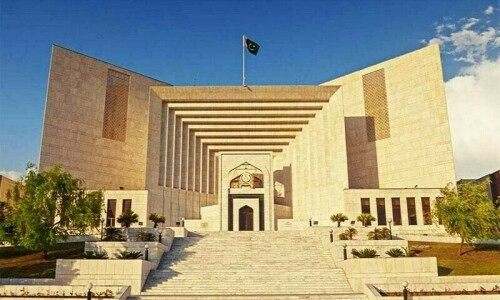
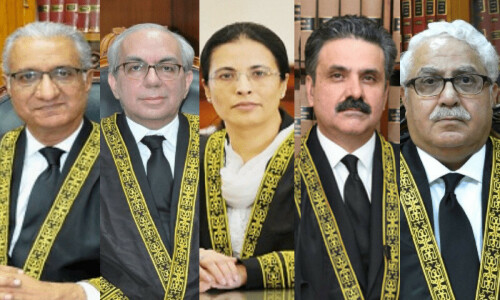
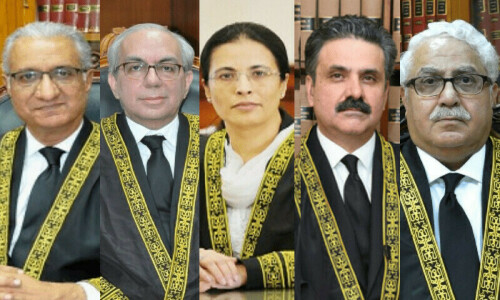
Headed by Justice Ijaz-ul-Ahsan, a five-judge SC bench had on Oct 23 emphasised that the cases of civilian accused involved in the May 9 attacks will not be tried, from now on, in the military courts but the criminal courts.
Fair trial rights
The Punjab government argued that the PAA and army rules provide every possible protection to the fair trial rights of the accused.
An overview of legal and procedural matrix of court martial and civil/sessions courts shows that both are not ‘at odds’, inter se; in fact, persons who are tried under the army act undergo a largely similar process in terms of law and procedure, in comparison with the ordinary civil/sessions trial, the appeal contended.
Specifically, the provisions of the Code of Criminal Procedure, 1898, relating to the framing of charge and recording of evidence are applicable in a trial by court martial, in a manner similar to a trial by a sessions judge. Most importantly, trials under the PAA are conducted — as closely as possible — in accordance with the orthodox practices of judicial proceedings, as established by Pakistan’s superior judiciary.
Also, during such trial, the accused is provided a ‘counsel’ of choice, in a manner similar to any other judicial proceedings, the petition said.
Targeted attacks
The ICA contended that the May 9 incidents involve targeted attacks on military installations and establishments in an organised and coordinated manner. The attacks were neither localised nor isolated, and indicated a premeditated and intentional attempt to undermine the country’s armed forces and inhibit the country’s internal security.
This is evident from the fact that several military establishments were simultaneously attacked during a short span of time. On that day, 62 incidents of violence were reported in Punjab alone in which approximately 250 people were injured, including 184 law enforcement personnel. Additionally, 139 vehicles, including 98 official vehicles, were partially or completely damaged.
As a result of the violence the total damage is estimated to be valued at Rs2.5 billion, including Rs1.9bn in losses to military establishments, equipment and vehicles. As a consequence of May 9 events, several FIRs were registered against the perpetrators while some others do not explicitly mention the provisions of PAA.
Several persons involved in the incidents were taken into military custody in accordance with the PAA and the army rules to be tried under offences contained in these laws.
Published in Dawn, November 25th, 2023