ISLAMABAD: The caretaker federal and Balochistan governments on Friday challenged the decision of the Supreme Court that declared military trial of civilians unconstitutional.
The appeals were filed a day after the caretaker government of Sindh moved the apex court against the decision of four of the five judges on the SC bench that declared Section 2(1)(d)(i) and (ii), and Section 59(4) of the Pakistan Army Act (PAA), 1952 ultra vires of the Constitution and of no legal effect.
The caretaker federal government has challenged the composition of the bench that heard the petitions.
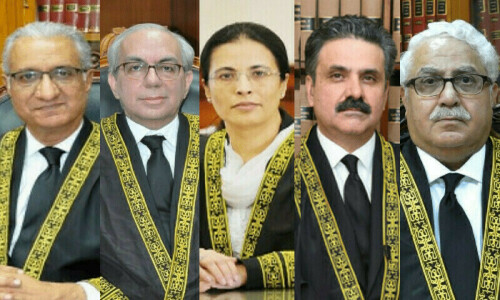
Headed by Justice Ijazul Ahsan, the SC bench had issued an order that 103 identified persons, as well as others who were or might be similarly placed on the list in relation to the events arising from and out of May 9 and 10, be tried by criminal courts of competent jurisdiction under the ordinary and/or special law of the land.
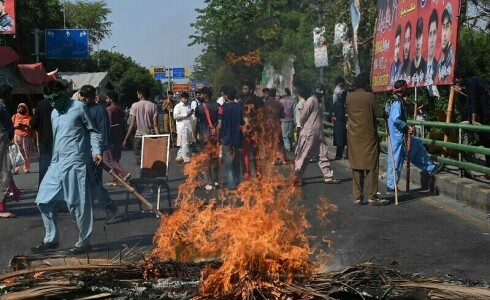
According to the appeal, the May 9 incidents involve targeted attacks on military installations and establishments in an organised and coordinated manner, as they were neither localised nor isolated. The events indicate a premeditated and intentional attempt to undermine the country’s armed forces and inhibit the country’s internal security.
It highlighted the short span of time during which the attacked were carried out on May 9.
It explained that 62 incidents of violence were reported across Punjab in which 250 people, including 184 law enforcement personnel, were injured. Also, 139 vehicles including 98 official vehicles were partially or completely damaged. The total damage is estimated at Rs2,539.19 million, including Rs1,982.95m in losses to military establishments, equipment and vehicles.
The federal government challenged the composition of bench that heard the petitions since it was not constituted in accordance with SC Practice and Procedure Act, 2023, which was suspended by court on April 13 before being restored on Oct 11, 2023.
As per Section 2 of the Act, the bench hearing petitions under Article 184(3) was to be constituted by a committee comprising Chief Justice of Pakistan and two most senior judges of the apex court. Under Section 3, matters invoking jurisdiction under Article 184(3) are to be first placed before the committee who upon examination will constitute a bench for adjudication of the matter.
The appeal said the petitioners were supposed to invoke the jurisdiction of high court first, before directly approaching the Supreme Court. The high courts could take up the petitions in such matters on grounds of mala fide, coram non judice and jurisdictional challenges, according to the caretaker government.
Also, the caretaker government in its appeal claimed that the Pakistan Army Act (PAA) ensures ‘fair trial’, stating that an accused person under Rule 33 of the Army Rules has the right to correspond with his legal advisers without censorship and interview any witness he may wish to and an accused person is entitled under Section 104 of PAA to object to any members of a court whose names are to be read out to the accused person.
Besides, Article 45 empowers the president to grant pardon, reprieve or respite and to remit, suspend or commute a sentence passed by a military court, the appeal argued.
The caretaker government mentioned that court martials and district trial courts (civil as well as sessions courts) have existed concurrently, since the creation of Pakistan, in 1947.
Published in Dawn, November 18th, 2023