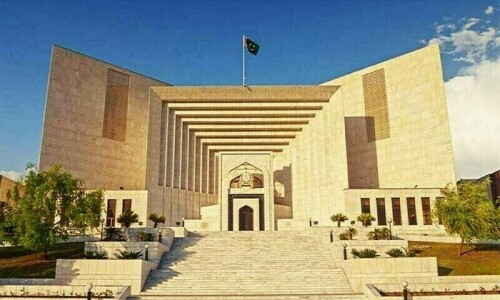
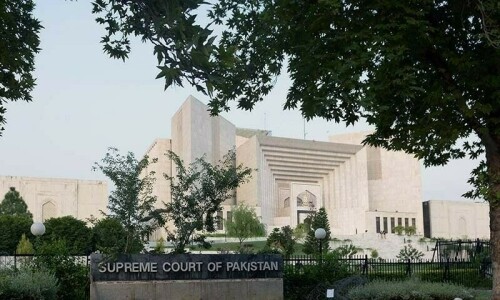
ISLAMABAD: The Supreme Court on Wednesday held the accountability watchdog, the National Accountability Bureau (NAB), cannot threaten, coerce or put under duress any individual being probed for corrupt practices for striking a commitment of ‘voluntary return’.
“Stipulated under Section 25(a) of the National Accountability Ordinance (NAO), voluntary return (VR) is simply an offer made by the person concerned, which if accepted by NAB would constitute a valid contract,” held Justice Syed Hasan Azhar Rizvi in a judgement he wrote. Justice Rizvi was a member of a three-judge bench, also consisting of former chief justice of Pakistan Umar Ata Bandial and Justice Ayesha A. Malik.
Therefore, NAB cannot unilaterally enhance the already agreed or settled amount under VR, Justice Rizvi emphasised, while accepting an appeal moved by Ghulam Mustafa Lund against the Sindh High Court’s rejection of his earlier plea on March 10, 2020.
Mr Lund, the petitioner, was a government officer in the finance department of Sindh. NAB initiated an inquiry into his alleged corruption, leading to his subsequent arrest on March 15, 2016.
Apex court says process depends on willingness to settle; graft watchdog cannot unilaterally increase previously agreed-upon amount
During the inquiry, the petitioner through a hand-written application made an offer to the NAB director general for VR and showed his willingness to return all assets gained or acquired by him.
NAB determined the petitioner’s liability to be Rs210.3 million, which the petitioner undertook to pay according to the provided schedule. The offer was approved by DG-NAB on March 29, 2016, after which the petitioner started making payments and was released from custody on April 27, 2016.
Later, NAB through a final notice on Feb 21, 2017, demanded an amount of Rs140.62m in addition to Rs210m from the petitioner on the grounds that the earlier liability was re-evaluated in compliance with April 2, 2016, orders by the administrative judge of the accountability court in Hyderabad.
NAB claimed that the earlier financial criminal liability calculated against the petitioner was ordered by the accountability court to be not properly assessed, and therefore the exercise should be undertaken afresh on the basis of the market value. The petitioner assailed the order before the SHC which was turned down.
In its judgement, the Supreme Court observed that the VR settlement was structured around and dependent upon the volition of the person who wished to settle. VR constitutes an offer of a holder of public office or any other person to make VR of the assets acquired or gains, acceptance of the offer by the NAB chairman and deposit of the amount with NAB.
The judgement said the accountability court has no role, power or authority to direct or supervise VR proceedings; the NAB chairman or his delegate is competent to accept the offer, though the NAB chief can reassess the liability under certain situations.
The Supreme Court held that NAB had admitted that the petitioner had made a full payment of Rs210m under VR as determined by DG NAB on March 29, 2016.
Thus the petitioner should be discharged of his liability, the judgement said while accepting the appeal against the SHC order.
Published in Dawn, October 19th, 2023