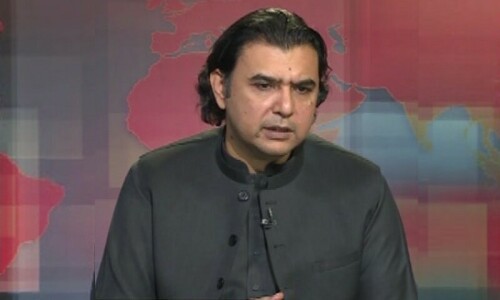
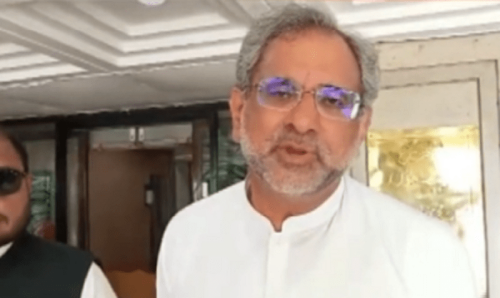
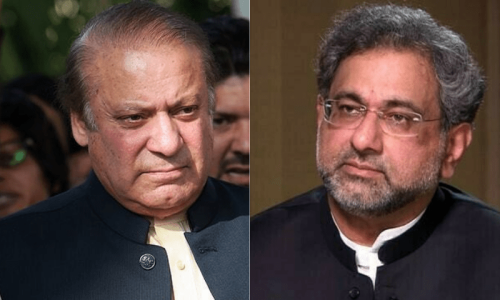
PPP’s Nayyar Bukhari doesn’t see Shahid Khaqan, Mustafa Khokhar and Miftah Ismail as ‘national level leaders’


PPP leader Nayyar Bukhari has questioned whether former senator Mustafa Nawaz Khokhar, ex-premier Shahid Khaqan Abbasi and former finance minister Miftah Ismail are “national level leaders”.
Last week, Khokhar had hinted at the formation of a new political party, saying it would be announced later this month as politicians gear up for general elections.
The former PPP senator, who parted ways with his party last year, had been on a speaking tour of the country alongside Abbasi and Ismail. The trio has long been hinting at introducing a new force into the political mainstream.
The three men have held a series of seminars — dubbed ‘Reimagining Pakistan’ — this year to highlight the country’s current challenges and develop a consensus on the future course of action required by all stakeholders.
Despite speculation to the contrary, Khokhar had earlier insisted that there were no plans to turn their current campaign into a political party. However, in recent times both he and Ismail have conceded the need for a new political party, while Abbasi has also been dropping hints that he may be close to parting ways with the PML-N.
If it is formed, the political party would be yet another that could enter the election fray. Other newly formed parties include PTI breakaway factions — Jehangir Tareen’s Istehkam-i-Pakistan Party (IPP) and Pervez Khattak’s Pakistan Tehreek-i-Insaf Parliamentarians (PTI-P).
Speaking on Dawn News programme ‘Doosra Rukh’ on Saturday night, PPP’s Bukhari started off by saying that he had great respect for Abbasi.
However, in the same breath, he also asked whether Abbasi was a “national level leader”. “He is definitely the leader of his constituency and has served as the prime minister but because of the PML-N,” he said.
Commenting on ex-finmin Ismail, he noted that the politician was based in Karachi and was an industrialist. “But what is his constituency? Does he have acceptability as a national leader? Or acceptability on a promise level?”
Bukhari posed the same question with regards to Khokhar, saying, “Mustafa Khokhar sahib too, does he have acceptability as a national leader? Can you compare them to Mian Nawaz Sharif or Bilawal Bhutto-Zardari or Maulana Fazlur Rehman?”
When the host pointed out that Abbasi was a former premier, Bukhari said, “Of which party? On his own basis or on the basis of the PML-N? If you minus ‘N’ from him, then what is left?”
During the interview, Bukhari was also asked about the JUI-F chief’s comments wherein he stated that the country was in dire straits and political parties were worried about the polls.
The PPP has been demanding timely elections while the JUI-F has raised questions over holding elections in Balochistan and Khyber Pakhtunkhwa at a time when they remain gripped by intense winter.
“Who will stabilise the country: That is my question Maulana sahib. Will you do it or will unelected people do it? Stabilising the country is the job of those elected by the people. That is why we say elections should take place,” the PPP leader said.
He said that only those who were elected through polls could stabilise the country. “This is correct that after polls, whatever the results are, all political parties should sit together despite who got the majority or not.
All political parties should decide whether they will cooperate with one another for the welfare of the country and the people, to take it out of crisis. But these things are for post-elections, not pre-election.“
He posed a question to the Maulana again, asking who had the right to take charge of the country. “The caretakers — who are not elected?”
Bukhari said Maulana was a “seasoned politician” and urged him to “go towards elections” and call on the Election Commission of Pakistan (ECP) to hold polls if not within 90 days then at least on the timeframe given, which is the last week of January.
“I think that the right of taking the country out of crisis, be it political instability or economic instability, was with the people’s elected representatives. Let elections happen, whatever the results, post-election political forces should sit and decide who will be the premier,” he said.
He added that parties should sit and also brainstorm on finding a solution for the “disturbed economy”.