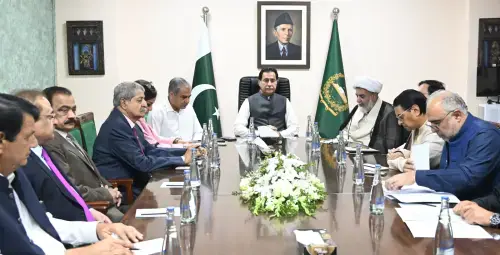
The Senate Standing Committee on Cabinet Secretariat has summoned the Ministry of Foreign Affairs and Attorney General for Pakistan (AGP) to brief the panel on objections reportedly raised by the US on the multi-billion-dollar Iran-Pakistan (IP) gas pipeline project.
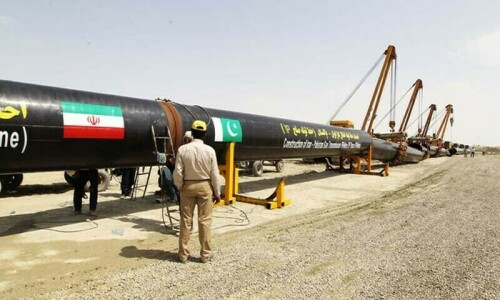
Tehran has been claiming to have completed its side of the 1,150-kilometre pipeline for which a groundbreaking ceremony was jointly conducted by then presidents Asif Ali Zardari and Dr Mahmoud Ahmadinejad on the Iranian site of Gabd, near Chahbahar in March 2013 with an estimated cost of $7.5bn at the time.
Pakistan had committed to complete its side of the project by January 2015. However, in February 2014 then petroleum minister Shahid Khaqan Abbasi told the parliament that the Iran-Pakistan project was “off the table” due to international sanctions.
Earlier this year, former petroleum minister Musadik Malik explained that despite being fully committed to its contractual obligations under the Gas Sales and Purchase Agreement (GSPA), the Government of Pakistan had been unable to start construction of the pipeline due to US sanctions on Iran.
Officials said Pakistan had requested Washington earlier this year for a solution for the project to help overcome energy shortages but had not yet received any response.
In August, Pakistan issued a notice of ‘Force Majeure and Excusing Event’ to Iran to suspend its contractual obligation on completion of the gas pipeline. Simply put, Pakistan had expressed its inability to pursue the project as long as US sanctions on Iran remain in place or Washington tacitly green lights Islamabad to go ahead with the project.
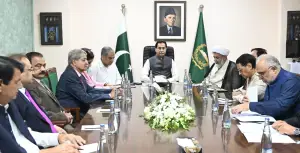
The matter came under discussion today during the Senate panel today.
Petroleum Additional Secretary Hassan Yousafzai briefed the committee that a deadline for 2024 had been given by Iran regarding the completion of the gas pipeline and failure to meet it would lead to fines.
“We are trying to renegotiate the matter with Iran,” he said, adding that efforts were being made to find out other ways of obtaining gas.
The secretary further expressed concerns that Pakistan could be subject to “liabilities of $20 billion”. The issue, he went on to say, was also raised with the US.
“Laying the gas pipeline till Gwadar will cost us $2bn,” he told the panel, adding that reneging on the deal with Iran could lead to a whopping $18bn penalty.
Commenting on the matter, Senator Mushtaq Ahmed called for summoning the Ministry of Foreign Affairs to “find out why can’t we purchase cheap gas from the neighbouring country”.
“We should know the reason behind the obstruction,” he said.
Meanwhile, the chairperson of the Senate committee, Sadia Abbasi, highlighted that India never faced such restrictions. “How was the agreement even signed amid these restrictions?” she asked.
Here, PPP Senator Waqar Mehdi said the agreement was signed under the government of ex-president Zardari.
The Iranian pipeline was aimed to supply 750 million cubic feet per day (MMCFD) of gas, although it was vehemently opposed publicly and diplomatically by the US authorities, particularly when Pakistan and Iran signed framework agreements and GSPA in 2009 and 2010 respectively.
Pakistan signed the pipeline agreement in 2014, which included a condition that Islamabad will pay billions of dollars in penalties if it abandons the project.