Foreign rescuers join Morocco quake race against time

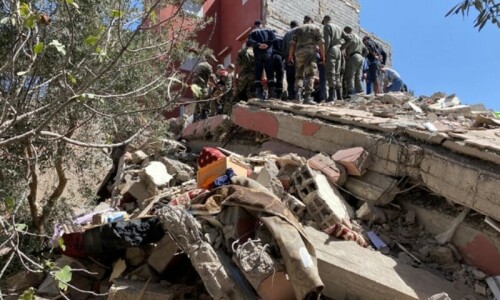
Rescuers on Monday faced a growing race against time to dig any survivors from the rubble of devastated villages in Morocco’s Atlas mountains, three days after the country’s strongest-ever earthquake.
The 6.8-magnitude quake that struck late on Friday southwest of the city of Marrakesh has claimed more than 2,100 lives and injured over 2,400, many seriously, according to official figures updated late on Sunday.
Rabat on Sunday announced it had accepted aid offers from four foreign nations, while many other countries have also said they were willing to send assistance.
Authorities have responded favourably “at this stage” to offers from Spain, Britain, Qatar and the United Arab Emirates “to send search and rescue teams”, the interior ministry said.
It noted the foreign teams were in contact with Moroccan authorities to coordinate efforts, and said only four offers had been accepted because “a lack of coordination could be counterproductive”.
Other offers may be accepted in the future “if the needs evolve”, according to the ministry.
France was willing to provide aid “the second” Morocco requested it, President Emmanuel Macron said.
A Qatari aid flight left from Al-Udeid air base outside Doha on Sunday evening, an AFP journalist said.
Spain has sent 86 rescuers and eight search dogs to Morocco to “help in the search and rescue of survivors of the devastating earthquake suffered in our neighbouring country”, said a defence ministry statement.
“We will send whatever is needed because everyone knows that these first hours are key, especially if there are people buried under rubble,” Spanish Defence Minister Margarita Robles told public television.
Villages flattened
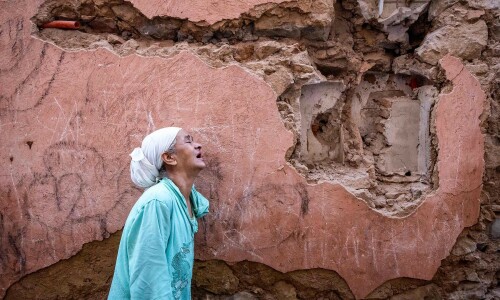
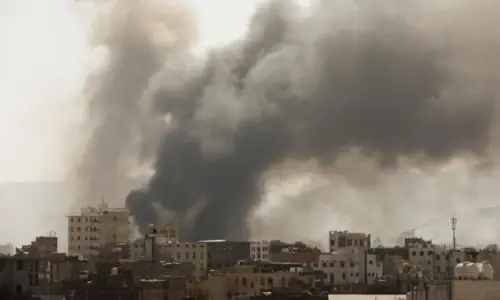
The earthquake wiped out entire villages in the hills of the Atlas mountain range, where civilian rescuers and members of Morocco’s armed forces have searched for survivors and the bodies of the dead.
Many houses in remote mountain villages were built from mud bricks.
The remote village of Tafeghaghte, 60 kilometres from Marrakesh in Al-Haouz province, was almost entirely destroyed, an AFP team reported, with very few buildings still standing.
“Everyone is gone! My heart is broken. I am inconsolable,” cried Zahra Benbrik, 62, who said she had lost 18 relatives.
Authorities recorded more than 1,300 deaths in Al-Haouz province alone.
According to Moroccan public television, “more than 18,000 families have been affected” by the quake in Al-Haouz, site of its epicentre.
The education ministry announced that classes in the worst-hit villages of Al-Haouz were “suspended”, and schools would not be open from Monday.
Citizens on Sunday rushed to hospitals in Marrakesh to donate blood to help the injured while many mobilised to help those affected.
Some parts of Marrakesh’s historic medina and its network of alleyways saw significant damage, with mounds of rubble and crumpled buildings.
The kingdom has declared three days of national mourning.
The Red Cross warned it could take years to repair the damage caused by the quake.
“It won’t be a matter of a week or two… We are counting on a response that will take months, if not years,” said Hossam Elsharkawi, its Middle East and North Africa director.
The quake was the deadliest in Morocco since a 1960 earthquake destroyed Agadir, killing more than 12,000 people.