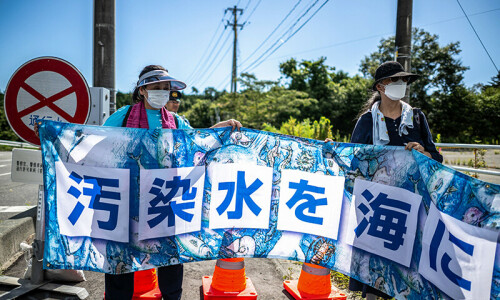
More than 100 fishermen and locals living near Fukushima will file a lawsuit this week seeking to stop the release of wastewater from the stricken Japanese nuclear plant, they said on Monday.
Twelve years after one of the world’s worst nuclear accidents, Japan began on August 24 discharging treated cooling water diluted with seawater into the Pacific, insisting it was safe.
Many Japanese fishermen have been against the release, fearing that it will undo years of efforts to improve the industry’s image in the wake of the 2011 catastrophe.
The more than 100 plaintiffs in Fukushima and neighbouring prefectures will file the lawsuit in the Fukushima District Court on Friday, Sugie Tanji, a member of the group’s secretariat, told AFP.
“The government failed to keep to its promise of gaining agreement from fishermen before taking such a decision to release,” she said.
“This is a wrong policy as it ignores strong opposition from not only the Fukushima fishermen’s cooperative but also from cooperatives across the country,” a group statement said.
“The release to the ocean can never be tolerated as it brings about further suffering to victims of the nuclear accident,” it added.
The water release has generated a fierce backlash from China, including a blanket ban on Japanese seafood imports.
Japanese government offices and businesses have also been bombarded with thousands of nuisance calls from Chinese phone numbers.
The Tokyo city government alone received 34,300 calls from August 24-31, it says.
Japanese government officials have made efforts to reassure the public that fish and other produce from Fukushima is safe to eat.
Last week, Prime Minister Fumio Kishida and the US envoy to Japan, Rahm Emanuel, among others, ate Fukushima fish in front of TV cameras.
‘Ours is the best’
Before the water release, China was Japan’s biggest export destination for seafood and Beijing’s ban has people in the sector worried.
Tokyo wholesaler Yoshinobu Yoshihashi’s business has seen shipments of items including oysters, sea urchins and splendid alfonsino to some Asian neighbours “more than half”.
“We’re having it quite rough,” Yoshihashi told AFP at the huge Toyosu fish market on Saturday.
“Especially in places like Hong Kong and Macau, the damage is quite acute. We’re hearing from our clients there that their customers aren’t coming in any more, and that they are shunning Japanese fish,” he said.
The Japanese government “should have done more to communicate globally the safety of the water before releasing it. There are some people even within Japan who say they’re scared,” he said.
“I have always been and still am proud of Japanese fish. Ours is the best,” he added.
Kishida has already promised aid for the industry and ministers were reportedly set to hash out details on Monday.