KARACHI: The Irtiqa Institute of Social Sciences on Saturday organised a programme about ‘Status of Agriculture in Sindh: Issues, Challenges, and Opportunities’ by rural development training specialist Professor Dr Muhammad Ismail Kumbhar and programme development expert Umer Karim here.
Speaking on the occasion, Dr Kumbhar recommended supplying water to coastal, desert, and semi-desert areas; sustainable and efficient utilisation of natural resources; productivity enhancement of major food crops such as wheat, rice, maize, and oil seed; encouragement to small enterprises; skill development, etc.
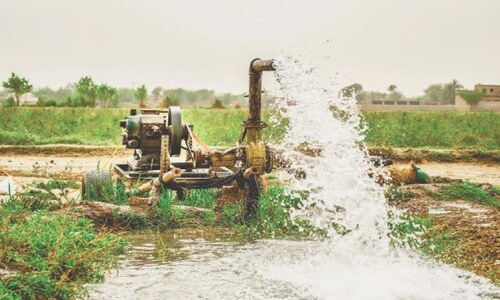
Talking about the country’s agricultural challenges, he highlighted food security and climate change, low agriculture productivity, increasing population pressure, decreasing land for agriculture, shrinking water resources, environmental degradation, including deforestation, diminishing energy resources, and overexploitation of groundwater as some of the key issues here.
Sharing some statistics, he said that the area of Pakistan is 79.61 million hectares, out of which more than 23.70m hectares are under cultivation, and most of this cultivated land is situated in the Punjab and Sindh provinces, which contribute about 19.5 per cent to the national gross domestic product (GDP) while providing employment to 40pc of the country’s labour force. It also provides food to 220 million people and a very large livestock herd, along with providing raw materials to large agro-based industries. About 65pc of the population lives in rural areas and derives their livelihood from agriculture.
Experts highlight challenges and opportunities for agriculture in Sindh
“Sindh’s coastline of 350 kilometres with thick mangrove forests is a very productive resource, which provides for 48pc of Pakistan’s fish exports. Moreover, 71pc of the marine resources, 65pc of the fish resources, and the majority of the saltwater fish resources of the country are located in Sindh,” said Dr Kumbhar.
“Sindh is rich in natural resources. Around 60pc of the country’s oil fields and 40pc gas fields are located here and contribute 65pc and 71pc of Pakistan’s daily oil and gas production, respectively. Sindh also has one of the largest coal reserves in the world in Thar, Sonda, Lakhra, and Badin,” he added. But then there are also things such as marketing and value chain issues, lack of mechanisation, government policies, land reform and security of land tenure, insurance coverage for crops, poor control over quality inputs, middlemen, deterioration of groundwater quality, etc., that show up as some of our many problems.
Meanwhile, programme development expert Umer Karim said that Sindh actually had four rivers, but most of these were seasonal and dependent on rains to fill up and flow into various areas of the province. He also mentioned how the sea is moving away from many coastal cities, such as Thatta, Badin, etc.
“The flow of the Indus blocked the sea,” he explained. “And where the riverwater evaporates, you find salt now,” he added, while explaining how so many areas in Sindh have turned into arid zones.
Mr Karim then brought up the irrigation system of the British. “We often hear these days that the colonial irrigation system ruined so much agriculture here. But it was our habit to dig up canals and streams. And the British only studied our ways to create their irrigation system here,” he pointed out.
“The barrages came later to facilitate their armies, and the British also carried out soil surveys that we have still not been able to do,” he said.
“The Indus flow with its source as the glaciers and monsoon rains raised the July to August flow in the river that would be used for irrigation in our fields then and also for other uses,” he added.
“But now, we don’t have the research or data to tell us how much water is needed where. As a result, we take more water than what is our actual need, then waste the extra water instead of using it for other needs of the population,” Mr Karim pointed out.
Published in Dawn, September 3rd, 2023