ON the day when Pakistan completes 76 years of sovereignty, and celebrates half a century of the implementation of its Constitution, there’s a palpable need to assess the present through the lens of Mohammad Ali Jinnah’s vision for this nation. His was an uncanny lucidity about matters of the state — the right to change dispensations and their policies rests with the electorate.
In a 1948 address to army officers in Quetta, he underlined that “executive authority flows from the head of the government … and therefore, any command or orders that may come to you cannot come without the sanction of the executive head”.
Earlier, on Aug 11, 1947, the principles of inclusiveness, impartial governance, rule of law, religious liberty, and social equality were made plain by the founder to the constituent assembly.
The founding fathers imagined an egalitarian, prosperous welfare state; one that thrived in harmony and justice with absolute civil supremacy. But decades after them, what emerged is entirely divergent from their beliefs. So this day begs the question: is ‘Jinnah’s Pakistan’ an ideal fading into a myth?
Our wounds and dilemmas are largely of our own making. For one, we reconstructed Jinnah — from a modernist to an orthodox — to suit prevalent narratives and enhance the power of clerics and the military in forming state policies.
Second, the continual infringement of the Constitution has left a faint watermark of what should have been a robust democratic culture. Recurrent military regimes arrested the political process. In fact, these have polluted political outfits that now, more often than not, collude with unelected elements to wrest power.
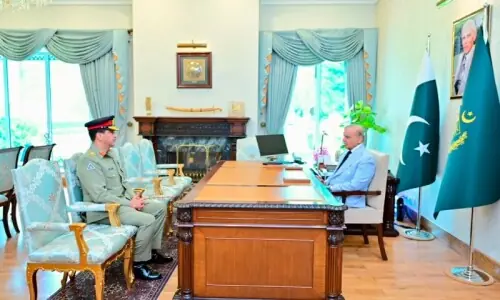
The military ruled Pakistan for three decades and has managed ‘chosen’ administrations. A recent glimpse of that was the hybrid model of the PTI-led government, which failed resoundingly, as have similar experiments.
This was replaced by a complete surrender of collective political space and a PML-N-led coalition was installed. Lastly, the rising tide of extremism turned Pakistan into a militancy hub.
Admittedly, there isn’t a magical way out, but stemming cronyism, corruption, and intervention is a good place to start. Salvation lies in retrieving Jinnah’s dream with the rule of law, education, health, welfare, and people power in a meritocracy. For non-political forces to usurp or derail the Constitution and cave into religious hardliners violates every ideal close to the Quaid’s heart.
Published in Dawn, August 14th, 2023