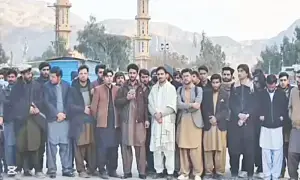
ONCE again, dozens of innocents have paid in blood for their state’s failure to apprehend an attack on the country and its people. At the time these lines were being written, at least 35 civilian lives had been lost to the cowardly bombing of a Sunday political convention in KP’s Bajaur district, while 85 individuals were battling with injuries of varying degrees, a number of them struggling between life and death.
The grief and anger came in familiar waves — it had been a while since so many civilian lives were lost to a single act of senseless violence, but we are certainly no strangers to the trauma.
We now process it as if by ritual. The standard condemnations have been shared and registered, and the mourners will now commit the deceased to their earthly abodes. Very soon, a senior official will, on record, express their institution’s ‘unshakeable resolve’ with regard to ‘eliminating terrorism’ from Pakistan. And that will be that.
It is important to consider why the workers of a religiously inclined political party could have been subjected to such bestial violence. However ultraconservative the JUI-F’s worldview, the party has chosen to contest power and operate within the parameters set by the Constitution of Pakistan.
This does not sit well with a host of militant organisations like the TTP, the IS-K and Al Qaeda, which have competed with democratic parties for control of the Pakhtun belt, particularly the tribal belts of KP and Balochistan. These groups, in the past, targeted and decimated the ANP and Qaumi Watan Party for the same reason.
The JUI-F, however, is an even bigger problem for them as it seeks a path to Islamic rule through the ballot box, while the militants seek the same through ‘jihad’ and to rule by the sword.
In the past, attacking political gatherings has had a chilling effect on the political activities of targeted parties and eventually pushed some of them out of the picture. With the country gearing up for elections, such terrorist outfits may seek to reassert their presence with fear tactics.
A UNSC report has only recently warned of the possibility of the TTP and Al Qaeda joining forces to expand their influence in South Asia. The occurrence of such incidents makes the Pakistani security apparatus look weak; the National Action Plan seems to have been ineffective in putting a stop to violent incidents.
The Taliban regime next door is also proving to be a problem. With the challenges growing, the national security apparatus cannot afford to take its eyes off the ball. However, of late, it seems to be taking too much on its plate. The fact is, criticism is sure to follow if its core responsibilities remain unfulfilled.
Published in Dawn, July 31st, 2023