0
0
A recent two-person show by Abida Dahri and Ishmal Rizwan, on display at the Sanat Initiative in Karachi, proved that two contrasting art styles can make for a surprisingly complementary art exhibition.
The art show had no title as such, which was a welcome change from the plethora of exhibitions in this country which are saddled with forced, tacked-on names in the spirit of seeming ‘artistic’ and ‘intellectual’.
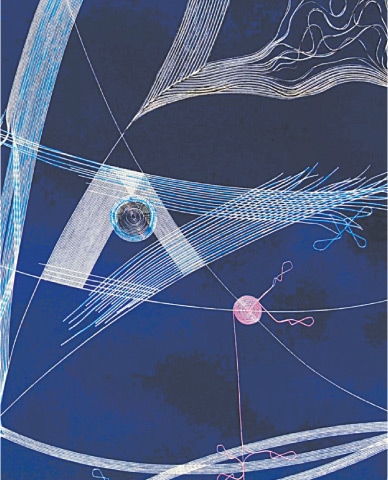
Dahri’s work is brimming with an exuberance that is further accentuated by her usage of masking tape and matte acrylic on wasli paper. The masking tape, in particular, gives a textured edge to her creations and allows for an experimental yet sensitive and minimal approach to her work. Dahri’s Underwater is a perfect encapsulation of her art practice, with its representation of disparate threads trying to find some sort of connection.
Her works attempt to bring our inner selves to life. According to Dahri, “What if we could imagine emotions, memories, perceptions and desires in a pattern? What would this look like? I have been interested in imagining and creating such patterns. The patterns I create are an emotional, religious, social, sexual or political state of mind.”
A mixture of abstract and hyperrealist artworks make for a captivating exhibition
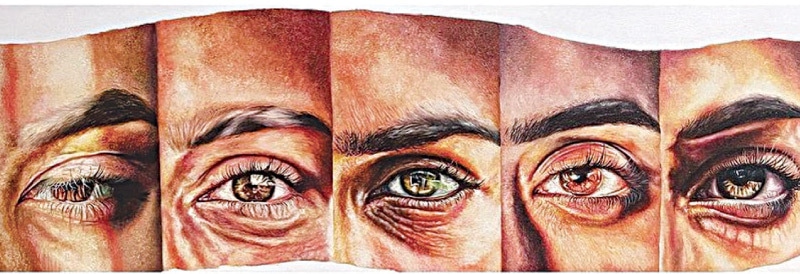
On the other hand, Rizwan’s work is not as abstract as Dahri’s, but it is equally intriguing. Over the past four years, Rizwan has dedicated herself to studying the intricacies of the human eye, and her artworks are the result of this ongoing exploration.
The detail of Rizwan’s canvas paintings is what immediately catches the eye (no pun intended). From afar, the close-up renditions of the human eye could pass for photographs. Upon closer inspection, one can’t help but marvel at the sheer detail and precision of the oil paintings.
The artworks Audience I and II represent observations and interactions signifying the power of the gaze and the connection between the artwork and the viewer. The paintings encourage a dialogue on what is seen and what is hidden, acknowledging the complexity of perception. Through this tension, Rizwan invites viewers to engage in the intricate interplay of the human eye and the layers of meaning it holds.
It is evident that Rizwan’s paintings are a celebration of the human experience, intent on capturing the essence of the intense gaze and emotions that come with it. What is also interesting to note is how much of her subjects she reveals in her renditions of the eye. Sometimes she gives us a glimpse of what the rest of the face looks like, revealing the texture and imperfections of the skin or the shape of the nose.
Whether it’s the piercing gaze of a predator or the gentle look of a loved one, her paintings are a testament to the power and beauty of the human eye, and the complexity of the human experience.
Abida Dahri and Ishmal Rizwan’s two-person show was on display at the Sanat Initiative in Karachi from July 6-13, 2023.
The writer is a freelance journalist
Published in Dawn, EOS, July 16th, 2023