

IAEA chief’s South Korea visit draws protests over Fukushima water release

Published July 9, 2023
South Korean people march towards Japanese embassy on Saturday during a protest against plan to discharge treated radioactive water from the tsunami-wrecked Fukushima plant into the ocean.—Reuters
Students wearing masks featuring Japanese Prime Minister Fumio Kishida, South Korean President Yoon Suk Yeol and International Atomic Energy Agency (IAEA) chief Rafael Grossi attend a protest against Japan’s plan to discharge treated radioactive water from the tsunami-wrecked Fukushima plant into the ocean, in Seoul, South Korea on July 7. — Reuters

SEOUL: Hundreds of protesters took to the streets of Seoul on Saturday during a visit to South Korea by the head of the UN nuclear watchdog aimed at calming fears over Japan’s plan to discharge treated radioactive water from its tsunami-hit Fukushima plant.

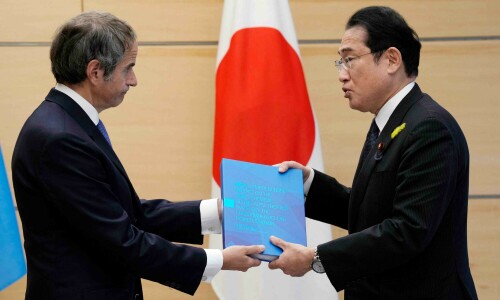
Rafael Grossi, director general of the International Atomic Energy Agency (IAEA), arrived in the capital on Friday to meet the foreign minister and a top nuclear safety official during his three-day visit after wrapping up a trip to Japan.

Foreign Minister Park Jin told Grossi Seoul’s consistent position was that contaminated water should be verified for safety and treated in a manner that complies with international law and standards, the ministry said in a statement.

Park also asked the IAEA for help in verifying safety and reassuring the public, the statement said.

Earlier in the week, the IAEA said that a two-year review showed Japan’s plans for the water release would have a negligible impact on the environment.

South Korea’s government has said it respected the IAEA’s report and that its own analysis had found the release will not have “any meaningful impact” on its waters.

Hundreds of people including children and members of the Korean Confederation of Trade Unions took to the streets on Saturday to protest the discharge plan, some carrying banners and blue balloons in the shape of whales.

“It makes little sense to argue that the release is okay because it does not harm humans. Animals also live in the ocean,” said university student Kim Han-bi.

Published in Dawn, July 9th, 2023
Opinion

Editorial

Iran stalemate
Updated 02 May, 2026

Iran stalemate

THE US and Iran are currently somewhere between war and peace. While a tenuous ceasefire — extended largely due to...
Tax shortfall
02 May, 2026

Tax shortfall

THE Rs684bn shortfall in tax collection during the first 10 months of the fiscal year is a continuation of a...
Teaching inclusion
02 May, 2026

Teaching inclusion

DISCRIMINATORY and exclusionary content in Punjab’s textbooks has been flagged in Inclusive Education for a United...
Water vision
01 May, 2026

Water vision

WATER insecurity in Pakistan has been building up for decades as per capita water availability has declined from...
Vaccine policy
01 May, 2026

Vaccine policy

PAKISTAN has finally approved its first National Vaccine Policy; a step the health ministry has rightly described as...
Labour rights
Updated 01 May, 2026

Labour rights

THE annual observance of May Day should move beyond statements about the state’s commitment to the rights of...





















