0
0

ONCE again, those already paying taxes are being shaken down to pay for our state’s ineptitude. When the government presented its budget for the next fiscal year earlier this month, our finance minister made some loud claims about how the country had already met all of the IMF’s conditions and also had a ‘Plan B’ in place in the event of its failure to revive the stalled bailout programme.
On the contrary, it is clear it was not until after Ishaq Dar’s budget presentation that the finance ministry actually began addressing the global lending agency’s concerns.
Desperate and short of time, it seems to have juggled some numbers, lifted some restrictions and finally resorted to what it always does best — squeezing active taxpayers further in order to shore up its balance sheet.
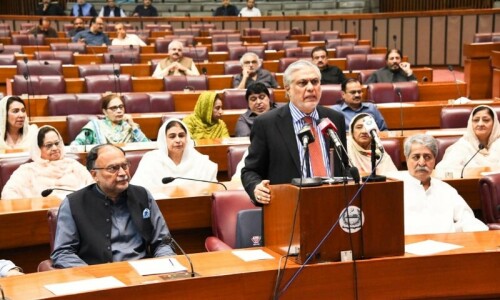
An official, commenting on the finance bill, noted that “this is the first time that parliament has passed a budget that it had not discussed and [to which] major adjustments were announced after the parliamentary debate was over”.
It seems that our lawmakers were more concerned about their travel plans than the citizenry’s growing list of troubles. Thanks to their disinterest, the finance bill signed into law will mean anyone making more than Rs200,000 a month will need to pay a higher income tax starting next month.
While Rs200,000 may have once been considered a ‘high’ income, the backbreaking inflation seen in recent months has considerably changed things. These days, the sum is just enough for a middle-class family to scrape through the month.
The higher tax rate will, in such a scenario, only encourage more people to dodge the taxman. It is already happening: almost a million taxpayers — about a fourth of the total — have ‘disappeared’ from the active taxpayer list issued by FBR for the latest tax year compared to a year earlier.
Why must responsible taxpayers always be the first to be penalised while a huge segment of the domestic economy remains undertaxed? As it is, there are high costs to social mobility for all Pakistanis who aspire to a better quality of life.
Most basic services — such as schooling, healthcare, water, electricity, gas and transport — have to be paid for out of pocket due to government failures to meaningfully address the crises endemic in each of these sectors.
How does adding an additional tax burden on top of these costs help towards reversing the brain drain that this country has experienced over the past year?
The answer is it does not: it is more likely to worsen the exodus. The government must tax the rich progressively — however, it clearly needs to upgrade its definition of whom it considers ‘rich’ enough, especially considering the impact of historic inflation over the past year on household incomes.
Published in Dawn, June 28th, 2023