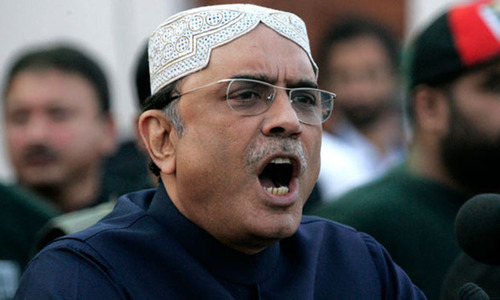
LAHORE: To put the sluggish economy on the fast track to recovery, former president Asif Ali Zardari has called for a long-term economic plan, based on collective thinking instead of individual interests and spanning over decades instead of yearly bailouts.
The PPP leader also rejected as mere propaganda the reports that Pakistan is spending too much on its defence, pointing out that the issue was not about overspending but of meagre earnings.
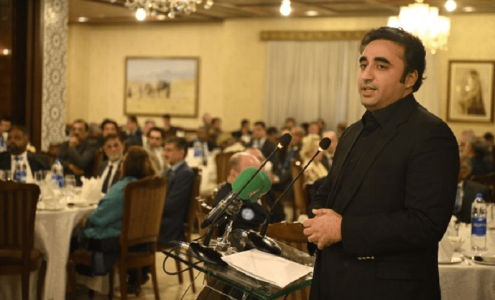
Speaking to businessmen at the Federation of Pakistan Chambers of Commerce & Industry (FPCCI) here on Wednesday, the ex-president highlighted the need for collective thinking and formulating a charter of economy spanning decades and generations rather than five or 10 years.
He quoted the example of China and urged the businessmen to sit together, form investment groups and make a 50-year plan that could also stabilise the national economy.
“The economic planning should aim at the welfare of future generations instead of [yearly] bailout. Our coming generations deserve a better economy and the country still has the potential and resources to move forward,” he said.
PPP leader calls for long-term economic plan; expresses alarm at sky-high interest rates
Assuring the potential investors of a state guarantee for their investments, Mr Zardari said if the opportunity was left only for foreign investors, they would not just invest but would also take out heavy amounts of the capital (as profit).
“The big businessmen of Punjab should sit together, choose industries and form investment groups (for joint ventures) and we’ll guarantee you loans and protection for your investment.”
The former head of state, whose party is a partner in the PDM-led government in the centre, expressed his concern at the extremely high interest rate of 21 per cent and termed it a joke with local investors, wondering at this cost who would like to invest in the country.
The PPP leader then advocated for adopting the public-private partnership investment model.
Mr Zardari called it a ‘thinking of colonial days’ to expect that only the public sector would make investment in all sectors. “Politicians’ job is to make policies and doing business is the domain of the businessmen,” he said, bringing applause from the audience.
In the Sindh province, where his party has been ruling for past 15 years, all bridges on the Indus River were built under a public-private partnership model, he said. Similarly, the private sector was running buses in Karachi, he added. However, in an indirect criticism of Lahore’s Orange Line Metro Train, the PPP leader regretted that instead of thinking about mega economic projects such as building the Gwadar port to revive the centuries-old Silk trade route, “we got engaged in building trains.”
‘Taxing the taxed’
He opposed further taxing the already taxed people, arguing the formula of trying to extract more juice from the squeezed oranges would no longer work. He quoted former Malaysian prime minister Mahathir Mohamad as saying that first people should be made rich before taxing them.
He argued that any tax should be levied only at the profit and not at prior stages of investment. He defended Sindh government’s policy of fixing higher rates of commodities, saying it saved the country from spending dollars to import the same commodities from abroad.
While rejecting as mere propaganda that Pakistan was spending too much on its defence sector, the ex-president said the issue was meagre earnings and not overspending. “If you take the national exports from the current level ($20 billion plus) to $250bn or $300bn, then you will forget how much is being spent on the armed forces or in any other sector. There’s nothing like that. They’re not spending any money. You’re not earning enough…,” he elaborated, calling for rising above that mindset.
In a reference to calls for constructing water reservoirs for generating power, the PPP leader said they were generating power through canals in Sindh and one could only imagine how many units of power could be generated through the canals in Punjab.
Published in Dawn, June 8th, 2023