World Bank okays $213m for flood protection



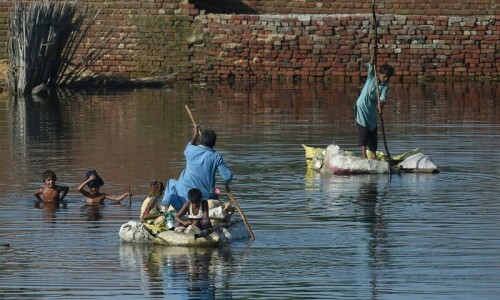
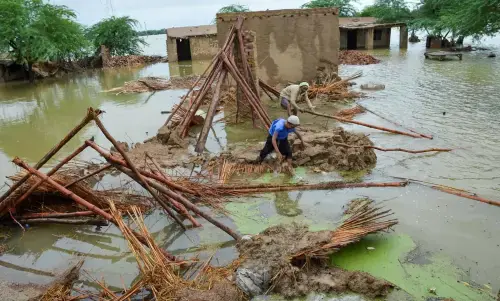
ISLAMABAD: The Board of Executive Directors of the World Bank has approved $213 million in financing to Pakistan to help improve livelihoods and essential services and enhance risk protection to communities affected by the 2022 floods, particularly those in Balochistan.
The announcement came after the conclusion of the two-day meeting of the International Partners Support Group (IPSG) at the Prime Minister Secretariat that so far projects worth $975m had been finalised for implementation including $575m financing from the Asian Development Bank and $400m by the World Bank.
“We will be working closely with the Government of Balochistan to support the affected communities by providing livelihood support and rehabilitating irrigation and flood protection infrastructures,” said Najy Benhassine, World Bank Country Director for Pakistan.
“This will not only help restore livelihoods but also protect the population by improving their resilience to potential future climate-related disasters and natural hazards. This project is part of the comprehensive package of post-flood rehabilitation and resilient-reconstruction programme agreed with the authorities.”
The Integrated Flood Resilience and Adaptation Project (IFRAP) will provide housing reconstruction grants to approximately 35,100 homeowners to rebuild their homes following resilience standards and livelihood grants to smallholder farmers to support livestock and promote climate-smart agriculture and other productive activities. It will also help restore essential services by rehabilitating damaged community infrastructure and facilities such as water supply, irrigation, roads, and community facilities.
The project is targeted to benefit approximately 2.7 million people in selected communities in calamity-declared districts across Balochistan. It will mitigate flood risks through a combination of resilient protection infrastructure, enhancing early warning systems, while ensuring that women have access to this system and disaster risk management information. IFRAP will restore degraded watersheds and strengthen institutional capacity at both the provincial and local levels.
The IPSG meeting presided over by Climate Change Minister Sherry Rehman was attended by ministers, advisers and secretaries of Economic Affairs, Planning, Development and Special Initiatives and Poverty Alleviation Division besides bilateral and multilateral development partners, diplomats and country representatives of the World Bank, Asian Development Bank, Islamic Development Bank, International Monetary Fund and UN aid agencies and other donors from European countries.
During the meeting, the Economic Affairs Division updated the implementation status of foreign assistance pledges made during the International Conference on Climate Resilient Pakistan, held in Geneva on Jan 9. The session was told that there was now “almost complete clarity” regarding the nature of the pledges made, according to a press statement.
It was noted that specific projects totalling $575m have been identified under ADB’s $1bn pipeline funds, with a focus on enhancing flood resilience.
Additionally, a negotiated amount of $400m with the WB has been allocated to the National Post-Flood Emergency Rehabilitation Project, while a separate agreement of $50.26m with IsDB has been established for the Sindh Integrated Health & Women Empowerment Project.
Published in Dawn, May 27TH, 2023