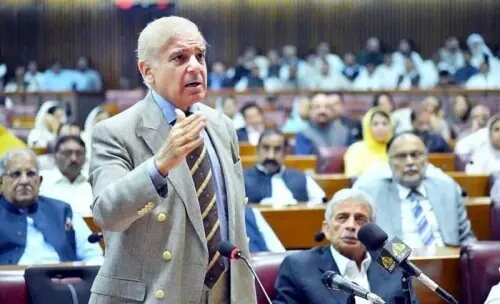
WASHINGTON: An annual US report has once again criticised the Pakistan Democratic Movement government for using the blasphemy card against former prime minister Imran Khan.
The US report on international religious freedom, which was released in Washington on Monday, noted that several political leaders used inflammatory religious language to attack their political rivals last year. The annual report covers 2022 events.
“On Sept 13, Pakistan Muslim League Nawaz party leader Javed Latif, in a press conference, accused former prime minister Imran Khan of ‘attacking the basic principles of Islam’ by ‘supporting’ the Ahmadiyya community while he was in office,” the report pointed out.
“Mr Latif accused Khan of giving interviews to foreign media in which he promised that Qadianis [Ahmadis] will be given religious freedom,” the report added.
The report also noted that JUI-F leader Maulana Fazlur Rahman tweeted messages on Sept 7 calling Mr Khan a “pro-Qadiani” and a “Jewish agent”. Leaders of the Pakistan Tehreek-i-Insaf responded by accusing the government of “spreading religious bigotry and hatred”, the report added.
Says blasphemy cases in Pakistan remain a substantial threat to religious freedom
Initial report
The US Commission on International Religious Freedom (USCIRF), which compiles the annual report, raised this issue in its initial report as well, which was released on May 1, noting that “the new government under Prime Minister Shahbaz Sharif, which took office in April 2022, weaponised the country’s blasphemy laws against Mr Khan and his cabinet members”.
The issue was also raised at a US State Department news briefing earlier this month when Spokesperson Vedant Patel said the United States “strongly oppose(s) laws that impede the ability of any individuals … to choose a faith, practice a faith, change their religion, not have a religion, or tell others about their religious beliefs and practices”.
The USCIRF report, which is sent to Congress as an official document, noted that blasphemy cases in Pakistan “remained a substantial threat to religious freedom, as did the sort of mob violence that has long accompanied such accusations”.
It called on Pakistan to repeal the blasphemy law, and until such repeal, enact reforms to make blasphemy a bailable offence.
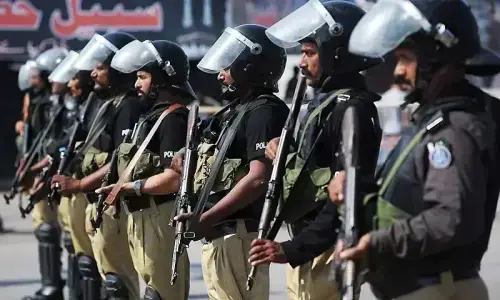
According to the report, police in Pakistan “at times killed, physically abused, or failed to protect members of religious minorities. And courts continued to enforce blasphemy laws, punishment for which ranged up to the death penalty”. The government, however, has never executed anyone for blasphemy, the report added.
Quoting reports by various civil society organisations, USCIRF reported that at least 52 persons were accused of blasphemy or related religion-based criminal charges during 2022, the majority of whom were Ahmadis.
At least four individuals charged with blasphemy during previous years received death sentences in 2022, two Christians and two Muslims.
The report noted that individuals convicted and sentenced to death in well-publicised blasphemy cases dating as far back as 2014, including Nadeem James, Taimoor Raza, and Junaid Hafeez, remained in prison awaiting action on their appeals.
Ramzan Bibi remained free on bail while awaiting trial for blasphemy.
In 2022, courts overturned some blasphemy convictions upon appeal and acquitted or granted bail to some individuals who had spent years in prison on blasphemy charges.
Those acquitted or released on bail include Qamar Aqash, Nadeem Samson, Stephen Masih Salamat, Mansha Masih, Mubasher Ahmad, Ghulam Ahmad, Ehsan Ahmad, Asim Aslam, and Mohammad Shahid Khan.
Published in Dawn, May 17th, 2023