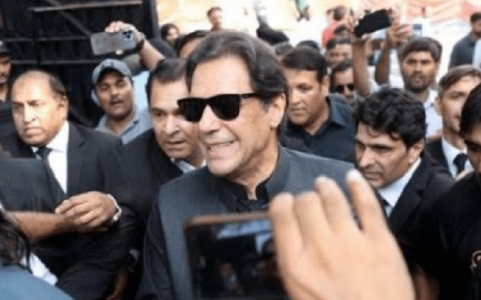
SOMETIMES, it seems that Imran Khan may just be singularly blessed. Within three days of the former prime minister being unceremoniously bundled out of the Islamabad High Court by a large contingent of the Punjab Rangers, a three-member bench of the Supreme Court headed by the chief justice yesterday deemed his arrest unlawful and took him into its own custody.
He was ordered to be sequestered for the night in Islamabad’s Police Lines Guest House and to appear before the IHC today, where he had earlier hoped to file a bail petition in the Al-Qadir Trust case before being arrested while he was still completing his biometric verification.
The government and Islamabad Police were further ordered to ensure Mr Khan’s security during his ‘stay’ at the guest house, and the court also instructed that he not be considered a ‘prisoner’ during this period.
Mr Khan’s arrest was deemed ‘illegal’ by the Supreme Court for having been conducted on court premises — a rule that has previously been upheld in other high-profile cases.
The arrest had previously been declared lawful by the IHC’s chief justice, in whose court it was executed, but many in the legal community had decried the reasoning as ‘weak’.
Government leaders were understandably furious at the development: Mr Khan’s arrest had come at a steep cost both for them and the country, and here the Supreme Court — already much-criticised by the present government for being ‘overly sympathetic’ to the PTI’s worldview — once again pulled him out of the state’s grasp.
Indeed, even if the reprieve granted to Mr Khan was partial and may prove very temporary, the speed at which he secured it does contrast sharply with the ordeals of several past prime ministers, who were summarily jailed and faced weeks and months of onerous court appearances and other tribulations in cases that were as politically motivated as the present one appears to be.
Mr Khan should remember that his legal troubles are far from over. While the manner of his arrest was deeply problematic, he must now face the charges brought against him without any further confrontation.
Trials and arrests are part and parcel of the Pakistani political experience, and he should not expect special treatment. Other leaders have also braved such tests and passed.
Moreover, Mr Khan has a huge responsibility to ensure that his supporters and sympathisers do not get into any further confrontation with the state. He must condemn in clear words the violence that broke out after his arrest and ensure that there will be no more of it.
His arrest opened an entirely new front in his party’s conflict with the PDM government as well as the military leadership. He must plot his path forward carefully and with responsible consideration for the consequences his decisions might entail.
Published in Dawn, May 12th, 2023