Economic, political uncertainty worsens poverty outlook in Pakistan: report
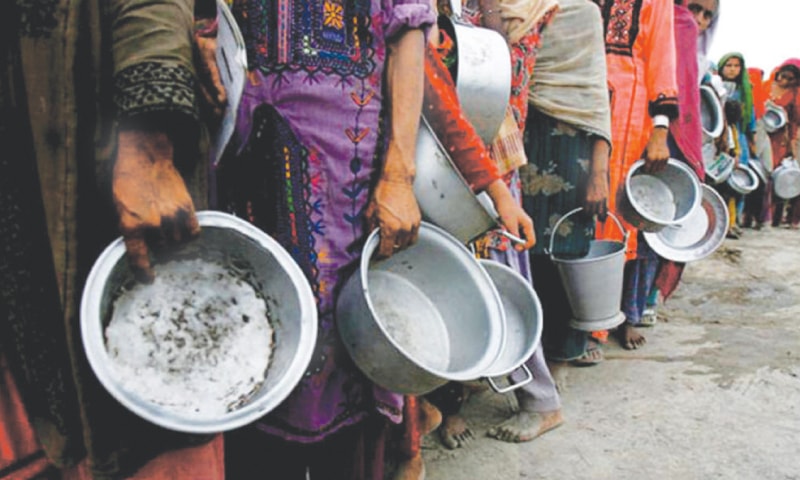


ISLAMABAD: World Bank sees poverty in Pakistan will inevitably increase with pressures from weak labour markets and high inflation, warning that further delays in external financing, policy slippages, and political uncertainty pose significant risks to the macro poverty outlook.
In the absence of higher social spending, the lower middle-income poverty rate is expected to increase to 37.2 per cent in 2022-23, according to the World Bank report on the macro poverty outlook for Pakistan, made available to Dawn on Saturday.
Given poor households’ dependency on agriculture, and small-scale manufacturing and construction activity, they remain vulnerable to economic and climate shocks.
Official remittance inflows also fell by 11.1pc, partly due to the exchange rate cap that made informal non-banking channels preferable. Any decline in overall remittances would reduce households’ capacity to cope with economic shocks, adding pressure on poverty, warns the report.
The report says Pakistan’s economy is under stress with low foreign reserves and high inflation. Activity has fallen with policy tightening, flood impacts, import controls, high borrowing and fuel costs, low confidence, and protracted policy and political uncertainty. Despite some projected recovery, growth is expected to remain below potential in the medium term.
Key risks to the outlook are the non-completion of the IMF programme due to policy slippages and the non-materialization of expected financing. Additional risks include political instability, deterioration of domestic security and external economic conditions, and financial sector risks associated with revaluation losses, liquidity shortages, and high sovereign exposure.
Health and education outcomes are also at risk as the high inflation and reduced incomes could lead poor households to lower school attendance and food intake, cautions the outlook.
With high public consumption, economic growth increased substantively above potential in FY22 at the cost of growing imbalances that led to pressures on domestic prices, external and fiscal sectors, the exchange rate, and foreign reserves. These imbalances were exacerbated by the catastrophic flooding in 2022, surging world commodity prices, tightening global financing conditions, and domestic political uncertainty.
Furthermore, distortive policy measures, including periods of exchange rate caps and import controls, delayed the IMF-EFF programme and contributed to creditworthiness downgrades, lower confidence, high yields, and interest payments, and the loss of access to international capital markets.
Agricultural output is expected to contract for the first time in more than 20 years due to the floods. Industry output is also expected to shrink with supply chain disruptions, weakened confidence, and higher borrowing costs and fuel prices. The lower activity is expected to spill over to the wholesale and transportation services sectors, weighing on services output growth. Output growth is expected to gradually recover in FY24 and fiscal year 2025 but remain below potential as low foreign reserves and import controls continue to curtail growth.
Due to higher energy and food prices, and the weaker rupee, inflation is projected to rise to 29.5pc in FY23 but moderate over the forecast horizon as global inflationary pressures dissipate. With dampened imports, the current account deficit is projected to narrow to 2pc of GDP in FY23 but widen to 2.2pc of GDP in FY25 as import controls ease.
The fiscal deficit is projected to narrow to 6.7pc of GDP in FY23 and further over the medium term as fiscal consolidation takes hold. The macroeconomic outlook is predicated on the completion of the IMF-EFF programme, sound macroeconomic policy, continued structural reforms, and adequate external financing.
Published in Dawn, April 16th, 2023