CONTACTS between visitors from the United States and political parties in Pakistan have definitely picked up pace, as the country inches closer to general elections. Last month, a US congressional delegation led by Senate Majority Leader Chuck Schumer visited Pakistan to discuss the “broad-based partnership” between the two countries.
After that, PTI Vice President Fawad Chaudhry met US Ambassador Donald Blome and apprised him of the ‘worsening human rights situation’ in the country.
Then, just last week, a delegation of lawmakers from the California assembly met PTI Chairman Imran Khan.
Sources say this engagement is the result of hectic lobbying by PTI representatives in the US, especially in areas such as California, Texas and Illinois (there is a sizable Pakistani presence in Houston and Chicago). Since their government’s ouster, PTI leaders, particularly those from Houston, have been hosting US lawmakers as part of their campaign to convince Americans that neither Mr Khan nor his party are against the US.
In August 2022, PTI hired a PR firm, Fenton-Arnook, to improve its image in the US, although the PTI chairman’s focal person for the US Sajjad Burki clarified that the firm would not lobby for the party.
“This is an agreement between a PR firm, not a lobbyist, and a group of US citizens,” Mr Burki told Dawn. “We are not lobbying for PTI Pakistan, and certainly not within the US administration.”
Last year, Mr Burki and his colleagues travelled from Houston to Washington to attend a fundraiser a Pakistani physician in Maryland hosted for the Karachi-born Senator, Chris Van Hollen, and contributed generously.
PTI leaders from Virginia, Maryland and New York are also involved in the campaign to rebuild PTI’s image.
This seems to be a departure from the status quo that prevailed until late last year, when engagements between the two sides were mostly limited to state functionaries. Now, it seems that both government and opposition parties are entertaining everyone from congressional delegations to the US ambassador and his staff.
In the immediate aftermath of the PTI government’ ouster, Washington became very cautious in the way that it conducted its diplomacy with Pakistan. This coincided with Imran Khan’s accusations of a US-backed conspiracy for his ouster, and as a result, the American response to any question about the political situation in Pakistan became quite formulaic.
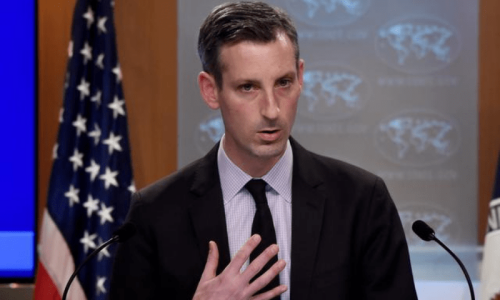
“The US does not have a position on one political candidate or party versus another. We support the peaceful upholding of democratic, constitutional, and legal principles. The US values our longstanding cooperation with Pakistan and has always viewed a prosperous and democratic Pakistan as critical to US interests,” Ned Price would say, whenever he was asked about Mr Khan’s allegations.
But even before the former PM accused a high-ranking State Department official of being part of a “regime-change operation”, the relationship between the PTI regime and Washington was conspicuously icy. Although he had travelled to Washington for an audience with Donald Trump, Mr Khan’s phone never rang after Joe Biden took office.
After his ouster, however, there seemed to be a thaw. The devastating monsoon floods offered a window for further rapprochement as the US became one of the biggest contributors of aid, giving over $50 million to support relief efforts.
But that flurry too seemed to cool off when Pakistan was unable to secure a lifeline deal with the International Monetary Fund in the final quarter of 2022. Hectic efforts were made by officials — such as former army chief Gen Qamar Bajwa, Foreign Minister Bilawal Bhutto-Zardari, and Finance Minister Ishaq Dar — who met a slew of US officials in an effort to win over the White House.
The recent resurgence of terrorism in the country and a deepening of the economic crisis is the latest opening that seems to have prompted a great deal of engagement between the two capitals, but this time around, the meetings aren’t confined to government functionaries alone.
In response to a Dawn query, a State Department spokesperson reaffirmed the commitment to stay engaged as Pakistan faced grave economic uncertainty.
“US foreign assistance to Pakistan has increased over the past year and the United States remains one of the largest providers of civilian assistance to Pakistan,” the spokesperson told Dawn when asked if Washington was willing to help stabilise the Pakistani economy.
“We have committed almost $33.5 billion in civilian and military support since 2002. No country is providing more grant-based assistance to Pakistan than the United States,” the official said.
“The United States has been a leading investor in Pakistan for the past 20 years and over the past year our investments went up 50 per cent.”
This is a familiar message; since December 2022, the State Department has reaffirmed its commitment to help Pakistan at least eight times.
However, observers believe that this is the most the US could officially say without being accused of overtly supporting the incumbent government.
It is clear that the US overtures were not limited to help during the current cycle of crisis and officials are, ostensibly, laying the groundwork for a continuing partnership, even if a new party takes power following the upcoming general elections.
The State Department official Dawn spoke to, gave the impression that Washington’s assistance isn’t contingent on who was in power. The itineraries of recent US delegations who have visited Pakistan also seem to suggest the same.
Published in Dawn, March 6th, 2023