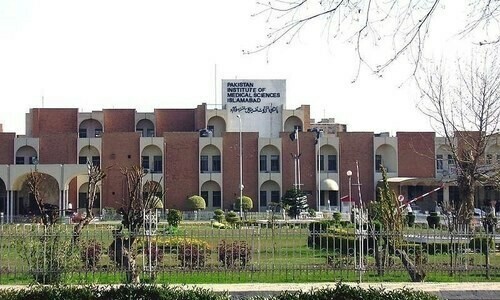
ISLAMABAD: An inquiry into the sale of infectious hospital waste in the market has revealed the “involvement of a senior official” of the Pakistan Institute of Medical Sciences (Pims) in the sale of hazardous waste instead of its disposal through incineration.
The report finalised by a three-member fact-finding committee was handed over to the Pims executive director who forwarded it to the ministry concerned for action against the officials involved in the malpractice.
Unlike past practices, the report has not been made public. Pims Executive Director Naeem Malik has also advised employees to keep an eye on malpractices and inform the management about them.
‘Blue-eyed vendor’
According to an official of the hospital, the inquiry committee found a number of discrepancies in the award of the contract to the company responsible for the disposal of the waste. Owing to the involvement of a senior hospital official, the administration has decided to involve the health ministry rather than taking any direct action.
An official of Pims, requesting anonymity, said that during the investigation it was revealed that there were a number of discrepancies in the award of the contract to the vendor. He claimed that conditions were made in the favour of the company which had to collect infectious waste and incarnate it.
Report finds multiple discrepancies in award of waste disposal contract to vendor
“During the investigation, involvement of a senior officer was also proved due to which, contrary to past practice of taking action against the involved persons, it has been decided to let the ministry act,” he said.
Pims Spokesperson Dr Haider Abbasi, while talking to Dawn, said the management decided to send the inquiry report to the ministry so that appropriate action could be taken. “The ED has given direction that the employees should directly inform him about the malpractices,” he said, adding that the management has also started taking action against encroachments on the hospital premises.
Sale of infectious waste
It is worth mentioning that on February 27, a vendor hired by the Pims administration to incinerate medical waste on the hospital premises was found involved in the sale of infectious waste with the help of hospital employees.
Subsequently, a three-member fact-finding committee was formed and Islamabad’s IG was also asked to register a case. The prime minister had also taken notice and directed an independent inquiry into this misconduct. Similarly, the National Assembly’s Standing Committee on National Health Services also took notice of the sale of infectious waste.
Pims installed an incinerator in 2018 that could burn 100kg of waste in one hour. It has a dual chamber — in the first step, it would burn the waste before converting it into ash. The ash is considered infection-free due to which it can be dumped in a pit or can also be given as municipal waste. It is worth mentioning that the management hired a company at a cost of Rs1.4 million per month to collect the hospital waste and incinerate it on the premises to avert recycling of the infectious waste.
Published in Dawn, March 5th, 2023