FM Bilawal warns terrorism will go beyond Pakistan if Afghanistan doesn’t act against militant groups

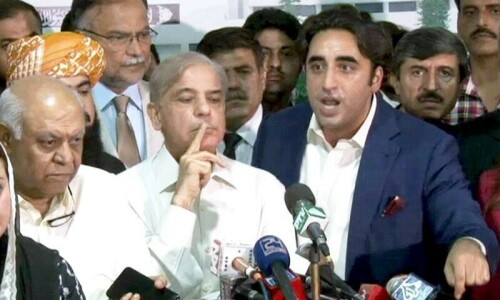
Foreign Minister Bilawal Bhutto Zardari on Saturday said that it would not take much time for terrorism to go to other places beyond Pakistan if the interim Afghan government did not demonstrate the “will and capacity” to take on militant groups operating from its territory.
Addressing the Munich Security Conference in Germany, the PPP chairman said the most important issue regarding Afghanistan in the region was the “security and terrorist threat emanating out” of the country, adding that there was a whole “alphabet soup” of terrorist organisations that were based out of Afghanistan.
He rued that not enough seriousness was paid to the issue by the international community or the Afghan government.
“The concern is that if we and the interim government don’t take these groups seriously and they don’t demonstrate the will and the capacity to take on terrorist groups then they will conduct terrorist activities in the region first — we are already witnessing an uptick in terrorist activity in Pakistan since the fall of Kabul — but it won’t be long before it reaches somewhere else.”
FM Bilawal urged the international community to act “pre-actively” rather than reactively after the “nightmare scenario”.
“The key is to convince … the interim government in Afghanistan with the international community’s consensus, to take on terrorism within their borders and demonstrate the will to do so,” he added.
He further told world leaders to find a way to build the capacity for the interim Afghan government to help it build a standing army.
“They don’t have a standing army, nor a counter-terrorism force or even proper border security,” he said. “In that situation, even if they have the will, they don’t have the capacity to deal with this [terrorist] threat which is a problem, first for the imminent neighbours and then the international community”.
The foreign minister cited how “very little attention” was given to Afghanistan after the fall of Kabul and the ongoing Ukraine war.
Bilawal gave an example of how banned militant groups such as the Tehreek-i-Taliban Pakistan, Balochistan Liberation Army and Al Qaeda were operating from Afghanistan while the international community was not doing enough to contain the threat.
“A lot of my time is taken to convince Afghan authorities to take on terrorists and address my security challenges,” Bilawal said, emphasising that terrorist groups have more coordination in Afghanistan than “we all do”.
The foreign minister said Pakistan did not want to “invade Afghanistan and go in after them and repeat the mistakes of the past” so the best scenario was for the respective law-enforcing institutions in Afghanistan to become functional.
Bilawal stressed that Pakistan would continue to help Afghanistan in any way it could and also called for opening the country’s banking channels, unfreezing its funds and building a “consensus based on Afghanistan’s realities”.
Afghan support for TTP
After the TTP called off its ceasefire on November 28, Pakistan has been hit by a wave of terrorism, mostly in Khyber Pakhtunkhwa, but also in Balochistan and the Punjab town of Mianwali, which borders KP. Terror attacks have also reached as far as Islamabad and Karachi.
A report released by the US Institute of Peace (USIP) on Tuesday said Afghanistan’s Taliban rulers are unlikely to discontinue supporting militants in Pakistan as they feel that economic troubles prevent Islamabad from launching a major operation against the TTP.
“Amid Pakistan’s economic crisis and the Taliban’s rule in Afghanistan, the Pakistani Taliban have reemerged as an increasingly potent threat,” warned the report.
Referring to Kabul’s recent criticism of Islamabad’s policies, the report argued that “this undiplomatic rhetoric underscores the Taliban’s determination to continue supporting the TTP, even in the face of intensified pressure from Pakistan”.
USIP argued that the Taliban’s response to being confronted about their support for the TTP “has been to level counter-accusations — which does not signal an impending shift away from that support”.