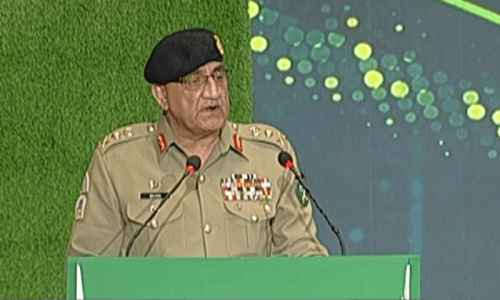
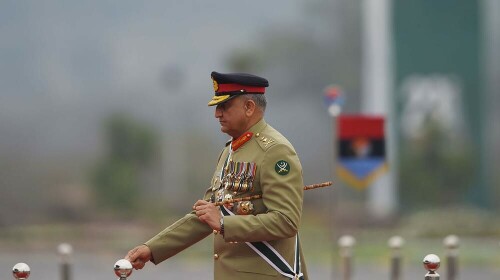
GEN Qamar Javed Bajwa’s farewell address at the Defence and Martyr’s Day ceremony on Wednesday was devoted to a rumination on the army’s role in politics, perhaps in recognition of the fact that it is what his legacy will be defined by.
There was an effort to come clean; a somewhat grudging acknowledgement that part of the blame for where things stand lay in the military’s history of political interference. But the general also assured us that the establishment’s days of political management are now firmly over; that the institution has, since February 2021, closed the chapter on 70 years of “unconstitutional” political interference.
This momentary self-accountability was inevitably followed by complaints.
Though the military had made mistakes, the public and political parties had recently gone too far when criticising the institution. The military was first vilified for bringing in a ‘selected’ government, and then for an ‘imported’ one, even though, in both cases, it had just been the politicians who could not accept defeat.
There was also clear annoyance with former prime minister Imran Khan, whose foreign conspiracy narrative has given much grief to the armed forces this year. Gen Bajwa implored the audience how it could be that the armed forces would have done nothing had there really been a conspiracy against the government.
At the end came the olive branch. The general said that the army had had chances to strike down critics, but these were foregone for the national good. However, the institution’s patience has bounds. As it starts a process of catharsis, the political parties, too, should introspect and re-examine their roles.
It was, undoubtedly, an unusual speech but perhaps fitting for these unusual times. Kudos to the chief for acknowledging the ‘unconstitutionality’ of the army’s role in politics and attempting to make amends. Time will tell if the institution sticks to his word.
Meanwhile, some questions remain. The good general failed to tell us what motivated his institution to quit politics in his last years in power. What role had he and the army played till February 2021, and why were they so full of remorse? And when Gen Bajwa eagerly claimed, on behalf of the armed forces, credit for resolving the Reko Diq and Karkey disputes, FATF whitelisting, and securing credit and cheap gas from friendly countries, did he consider for once that the army had no business interfering in any of these matters?
Lastly, when the military eventually realised its mistakes in political interference, did it also rethink its policies on militancy, some of which had contributed to Pakistan’s greylisting by the FATF? Otherwise, was it not unfair for it to take credit for solving a problem it had created itself?
Catharsis will come whenever the institution confronts the ghosts of its past. Gen Bajwa has started the process; one hopes it will carry on.
Honesty and sincerity in the civil-military relationship may just be what is needed to make the country whole again.
Published in Dawn, November 24th, 2022