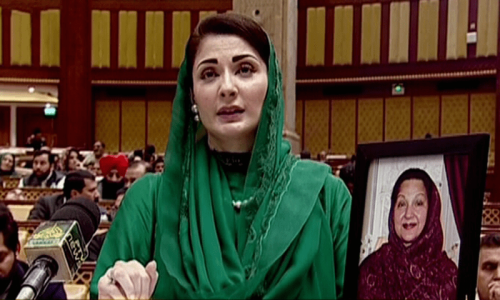
LAHORE: The session on ‘Reluctance to Criminalise Enforced Disappearance and Arbitrary Detentions’ at the Asma Jahangir Conference saw emotional scenes where activists and family members of the missing people narrated their struggle to retrieve their near and dear ones from the state operatives.
Azam Nazeer Tarar, head of the committee on enforced disappearances and federal minister of law and justice, became the centre of criticism by speaker after speaker after he opened the session to take credit for the recent passage of a bill by the National Assembly which criminilises forced disappearance.
Sammi Deen Baloch, human rights activist and daughter of a missing person, thanked the minister for the bill but added her scepticism about its implementation.
“Our lives have been spent in front of press clubs and on roads, demanding the return or trial of our people missing for years, but to no avail,” she said to the minister. “We have seen such bills and commissions since 2011, but their implementations remain a distant dream. What will you say about the recent legislation against torture, and for a free and fair trial for every prisoner? Has any culprit been punished?”
She reminded the minister and the audience that in 2010, rights activists demanded that a report on missing persons be made. In 2012, the top judge ordered the trial of 34 FC personnel in the case of missing persons and ordered the immediate retrieval of missing persons. In one such ruling, the court ordered the government to assume the missing persons, who are government officials, were alive and that their salaries should be restored. In 2015, as per a court order, no unclaimed body could be buried without a DNA test.
“What happened to these commissions, their reports and court rulings?” “Nothing,” she roared.
She said the media would report celebrities’ shoes, but not the missing humans of Balochistan.
Akhtar Jan Mengal, former chief minister of Balochistan and chairperson of the Balochistan National Party-Mengal, said he had made endless speeches in all forums, including parliament and the court of law, on the persecutions of activists in Balochistan, KP, and even parts of Sindh and Balochistan. He advised Minister Tarar to reach out to the families of every missing persons if the government was serious about gauging the gravity of the issue.
Manzoor Pashteen turned out to be another firebrand speaker, naming national institutions behind the killings of people in former Fata areas under the policy of “state of exceptions” imposed on Pashtun. He said that since 2001, normal rules were changed and a new narrative about national security was built. The new regime targeted and terrorized every journalist, individual, and group that followed independent thinking. He said MNA Ali Wazir was being denied a production order because of his free speech. He said media, courts, parliaments and civil society were powerless to tackle the power targeting free thinking. “The only way out is resistance,” he said.
Sher Mohammad, president of the High Court Bar Association, Mingawara Bench, shared his struggle for the release of missing persons in Pata and Fata areas with the late Asma Jahangir. Nothing worked out. If he got a favourable verdict against a military court ruling, the Supreme Court suspended it. Shabbir Hussain Gigyani, senior lawyer of the Peshawar High Court, said the recently passed bill on criminalising enforced disappearance, was, in fact, moved by the previous government. It was passed by the National Assembly, but went missing in the Senate. He feared the same fate of the recent bill in the Senate too.
Angkhana Neelapaijit, member of the United Nations working group on enforced or involuntary disappearances, cited different international laws which criminilsed enforced disappearances. She said the working group demanded that Pakistan stop enforced disappearances and personal freedom is upheld. The moderator had to act as a good cop and bad cop to manage time.
Published in Dawn, October 24th, 2022