• Seeks balance between ‘strong army’ and ‘strong govt’
• Gets bail in FIA case; tells workers to prepare for another ‘final call’
LAHORE / ISLAMABAD: Former prime minister Imran Khan on Wednesday said that during his three-and-half-year tenure, decision-making powers did not lie with him, even though he was in charge of running the affairs of the country.
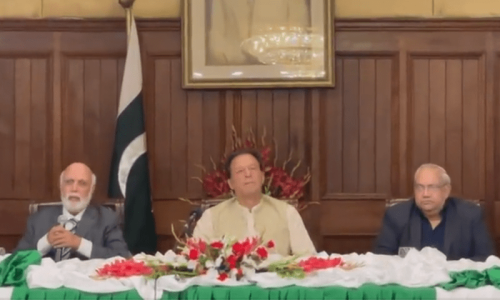
The statement by the PTI chief, acknowledging his helplessness despite being at the helm of the affairs, came during a conversation with media persons in Lahore. Mr Khan also blamed the bad governance during his tenure on the ‘de-facto’ rulers who, apparently, did not let him turn his dream of ‘Naya Pakistan’ into reality.
During my tenure, running the affairs of the country was supposed to be my responsibility, but the “orders were coming from somewhere else”, Mr Khan said, while referring to his tenure. He added that if he had enjoyed complete authority, his administration could have competed with the reign of Sher Shah Suri – founder of the Sur empire that ruled north India in the 16th century.
Mr Khan did not name the people he had to ‘share the power’ with, but he has made similar claims in the past. In an interview in June, the former prime minister had admitted he did not enjoy absolute power, indicating that the actual centres of power in the country lay elsewhere and “everyone knows where that is”, reported Dawn.com.
‘Hands were tied’
The former premier also talked about pressures during his time at the helm. “Our hands were tied. We were blackmailed from everywhere. Power wasn’t with us. Everyone knows where the power lies in Pakistan so we had to rely on them,” Mr Khan said.
“We relied on them all the time. They did a lot of good things too but they didn’t do many things that should’ve been done. They have the power because they control institutions such as NAB, which wasn’t in our control,” Dawn.com quoted him as saying.
Mr Khan also talked about a need to strike a balance between a ‘strong army’ and a ‘strong government’ since, in order for the system to work efficiently, the responsibility and the authority needed to be vested in one office.
He also took swipe at the ‘handlers’ who, according to him, had “damaged the country more than its enemies” by allowing the ‘looters’ to get clean chits. There was an open and shut case of Rs16 billion corruption against Prime Minister Shehbaz Sharif, but he had the “protection of handlers”, Mr Khan claimed while commenting on the acquittal of the premier and his sons in the money laundering case.
Several engagements
The PTI chairman spent a busy day in Lahore. He addressed a ceremony of the trade unionists and Insaf Student Federation (ISF) as well. Speaking at the oath-taking ceremony of the ISF, the former premier asked his party workers to be ready for the long march. “It won’t be long now,” he told the ISF activists. The final call can be given any time, Mr Khan reiterated followed by the administration of oath to the ISF workers by PTI leader Faisal Javed.
At a public meeting in Sharaqpur, Imran Khan said he did not need to install his “own army chief, judges, police chiefs, or the NAB chief” because he would never break the law or indulge in corrupt practices. “I want that all top institutions’ heads should be appointed on merit to strengthen the institutions,” he said while referring to the appointments made by the incumbent government. He alleged that the current rulers wanted to bring their own people into these offices to hide their corruption.
Separately, the PTI chairman addressed a workers’ convention in Islamabad before his departure to Lahore after he was granted bail in a case registered by the Federal Investigation Agency over the submission of a ‘fake affidavit’ to the Election Commission of Pakistan (ECP).
Imran Khan recalled his government’s achievements and said that foreign remittances and investments in addition to tax collection were increasing before his ouster in April.
Bail in FIA case
Earlier in the day, the Islamabad High Court (IHC) granted Imran Khan pre-arrest bail till Oct 18 in the FIA case against him. The registrar initially raised objections to the petition, but it was subsequently taken up by the IHC chief justice, Athar Minallah.
At the outset of the hearing, Barrister Salman Safdar explained the reason for invoking the jurisdiction of the high court.
Justice Minallah recalled that in the past, the court entertained such a petition of former senator Faisal Raza Abidi and granted him protective bail. He, however, pointed out that the presence of the accused was a mandatory requirement to seek relief. Barrister Safdar promptly offered that Mr Khan could appear in the courtroom within 30 minutes and Justice Minallah granted protective bail after the PTI chairman appeared before the court.
The IHC CJ did not dispose of the petition, though, and kept it pending since the counsel of Mr Khan said that there was still confusion regarding the jurisdiction of the trial court. Justice Minallah observed that since the offences fell within the ambit of the Federal Investigation Agency (FIA); therefore, the special judge central was competent to take up the matter.
IHC Chief Justice remarked that Mr Khan could surrender before the trial court by the date fixed; however, the IHC may take up this matter again at the next date if the jurisdiction issue remained unresolved.
Published in Dawn, October 13th, 2022