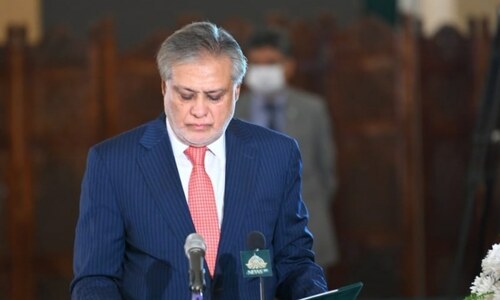
New finance minister Ishaq Dar known for propping up rupee in earlier stints


Ishaq Dar, who is set to become Pakistan’s new finance minister, has strongly favoured intervention in currency markets in three previous stints in the job, but faces a nation in economic crisis this time and the conditions of an International Monetary Fund (IMF) programme.
Dar, a seasoned politician and chartered accountant, was sworn in as a federal minister on Wednesday.
The 72-year-old faces the daunting task of stabilising an economy that has for months been in a tailspin facing multiple threats of high inflation, a widening current account deficit and falling reserves — and is now reeling from devastating floods.
Currently a senator, Dar comes with a strong reputation from previous stints as finance minister, most recently from 2013 to 2017.
Editorial: If the past is anything to go by, Ishaq Dar’s arrival could portend more trouble for economy
“Dar is an interventionist,” economist and former Citigroup banker Yousuf Nazar told Reuters.
The minister is most famous for strong-arming the central bank to liberally inject foreign exchange into the market to prop up the rupee.
“He would like to see lower interest rates and a stronger rupee,” Nazar said.
But he added the current global environment and the running IMF programme would not allow Dar to pursue his signature policies.
Foreign reserves currently stand at a level that cover just over a month of imports — which makes intervention difficult.
In addition, under the ongoing IMF programme, Pakistan has agreed to a market-based currency exchange regime and earlier this year passed a law that gave the central bank more autonomy and insulated it from government pressure.
Dar’s predecessor, Miftah Ismail, was a proponent of following a painful IMF stabilisation programme, which included removing fuel and power subsidies, despite the political cost with inflation rising above 27 per cent year-on-year and the rupee tumbling to historical lows.
Recently, however, the government said the IMF has indicated it would soften programme conditions because of the devastating floods that are estimated to have caused around $30 billion in losses, and will slow growth this year to below 3pc from an earlier estimate of 5pc.
Ahead of Dar’s notification, the rupee has risen for the last three sessions this week — either an indication that the market was inflated because of a lack of control or because it was pricing in intervention.
‘No rookie’
“Mr Dar’s main challenge is to stabilise the exchange rate in order to put the genie of massive inflation back in the bottle,” Aqdas Afzal, an economics professor at Karachi’s Habib University, told Reuters, adding the government wanted to use Dar’s previous experience of taming inflation, which it desperately needs ahead of the next elections.
“Dar is no rookie when it comes to handling the economy,” he said.
But Dar’s policies have a lot of critics, who say he ensured the rupee remained over-valued and hurt the balance of trade. It was this policy, critics say, that inflated the current account deficit to record levels of nearly $20 billion in the 2017-18 financial year.
The country had to return to the IMF for support months later in 2019.
An advantage for Dar is that he enjoys the complete trust of former premier and PML-N supremo Nawaz Sharif.
Dar is also related to the Sharif family by marriage. His son is married to Nawaz’s daughter, giving him a seat in the inner-most circle of the party and the freedom to make quick decisions and cut through bureaucratic red tape.
Managing the economy will not be his only challenge: He returns to Pakistan after five years of self-imposed exile, during which time he has been declared a fugitive by a Pakistani court because of his failure to appear in anti-graft proceedings against him.
Dar says the case is politically motivated.
Read: Dar finally shows up to Islamabad NAB court, says couldn’t return earlier due to ‘passport seizure’
His arrest warrants were suspended last week by the court, clearing him to travel to Pakistan without fear of arrest until Oct 7.
Dar attended chartered accountant institutes in London and Wales after studying commerce and accounting in Lahore. He entered politics in the 1980s and has multiple stints as a parliamentarian.
He has previously been finance minister in 1998-99, 2008 and 2013-17 — besides holding portfolios of commerce, trade, industry and investment.