US warns of sanctions against Turkey over Russia ties


Turkey's business community confronted growing US pressure on Wednesday to break off its growing ties with Russia or face potentially crippling sanctions linked to the Kremlin's invasion of Ukraine.
Washington is becoming increasingly alarmed that the Russian government and businesses are using Turkey to evade Western financial and trade restrictions imposed in response to the six-month-old war.
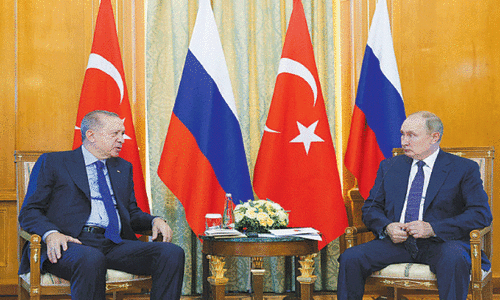
Turkish President Recep Tayyip Erdogan and Russian counterpart Vladimir Putin agreed to step up economic cooperation at a summit in the Black Sea resort of Sochi earlier this month.
Official data shows the value of Turkish exports to Russia between May and July growing by nearly 50 per cent from last year's figure.
Turkey's imports of Russian oil are ballooning and the two sides have agreed to transition to ruble payments for the natural gas exported by the Kremlin-tied giant Gazprom.
US Deputy Secretary of the Treasury Wally Adeyemo paid a rare visit to Ankara and Istanbul in June to express Washington's worries that Russian oligarchs and big businesses were using Turkish entities to evade Western sanctions.
Nato member Turkey — on good terms with both Moscow and Kyiv — has tried to stay neutral in the conflict and refused to join the international sanctions regime.
'Risk of US sanctions'
Adeyemo followed that up with a letter to Turkey's Tusiad business association and the American Chamber of Commerce in Turkey, warning that companies and banks were in danger of being sanctioned themselves.
Tusiad said in a statement late on Tuesday that it had passed on the letter to Turkey's foreign ministry as well as finance and trade officials.
The letter's contents were first reported by The Wall Street Journal this week.
“Any individuals or entities providing material support to US-designated persons are themselves at risk of US sanctions,” Adeyemo wrote.
“Turkish banks cannot expect to establish corresponding relationships with sanctioned Russian banks and retain their corresponding relationships with major global banks as well as access to the US dollar and other major currencies.”
The economic cooperation agreement sealed by Erdogan and Putin includes a deal for more Turkish banks to start processing Russia's Mir payments system.
Broader cooperation with Russia could help support Turkey's ailing economy in the run-up to next year's general election.
Adeyemo raised US concerns again in a phone call to Turkey's Deputy Finance Minister Yunus Elitas last Friday.
“Underlining that it has deep economic and political relations with Ukraine and Russia, Elitas said that Turkey's position [on joining] the sanctions has not changed,” Turkey's finance ministry said in a statement about the call.
The finance ministry added that “it will not allow any institution or individual” to use Turkey to evade the sanctions regime.
Erdogan has previously argued that Ankara cannot join Western sanctions on Moscow because of Turkey's heavy dependence on Russian oil and natural gas imports.
Some analysts believe that Tusiad and the American Chamber of Commerce in Turkey — largely made up of big businesses with a global reach — are unlikely to violate the regime because they place more value on open access to US financial markets.
Timothy Ash of BlueBay Asset Management in London told AFP that “smaller, domestically focused” companies were more likely to strike deals with sanctioned Russian entities that opened the way to two-way trade.
“It worries me though that the message from the top in Turkey seems to be that it's fine to do more business with Russia, and it's important to try and exploit opportunities to counterbalance costs from sanctions, even prosper from them.”