3
3

THERE has been a debate on having more dams amidst water crisis that has made us treasure our water resources and focus on preserving what is fast turning into a precious entity. But one wonders if we have taken too long to have this realisation.
Manchhar, the largest freshwater lake of the country and perhaps one of the biggest in the continent, is an existing source that may reduce water scarcity to some extent. But, unfortunately, it stands poisoned and polluted owing to sustained apathy on the part of the authorities concerned.
In the 1990s, the federal government decided to construct the Right Bank Outfall Drain (RBOD) to take the effluent to the Arabian Sea. The first phase was started, but till its completion, it was decided to drain the effluent into Manchhar through the Main Nara Valley (MNV) drain.
In 2001, the RBOD II project was initiated, which was a continuation of RBOD I. Gharo Creek was finalised as the effluent disposal point. The project was later handed over to the Frontier Works Organisation (FWO) in 2006, and the capacity of the project was increased. It was finally decided that the project would be completed by 2008.
Everyone dreamt of that day, but all such dreams have remained just that; dreams. In the meantime, Manchhar has lost its flora and fauna due to pollution. There is no lotus cultivation in the lake. Out of 40 different fish species, 30 have vanished. According to an estimate, during the 1950s, the fishermen would catch 3,000 tonnes of fish. Now they get no more than 40 tonnes.
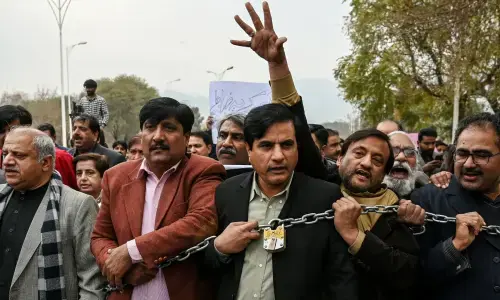
About 40,000 fishermen have left their boat houses (pictured above)and migrated to urban areas. Manchhar is now a story of sorrow. All the authorities do is to complain about lack of funds.
The federal government justifies that after the 18th amendment the lake is the sole responsibility of the provincial government which must now carry on the project. On the other hand, the provincial authorities say the project was the brainchild of the federal government, and it cannot fund such a large project on its own. The villagers and fishermen are the main losers in this tug of war between the federal and provincial governments.
In 2015, the Supreme Court of Pakistan took sou motu notices over the destruction of Manchhar. It subsequently passed orders for the installation of treatment plants. Unfortunately, no one in the decision-making machinery paid heed to the orders.
In 2020, the provincial Anti-Corruption Establishment (ACE) unearthed misappropriation worth Rs4.4 billion in RBOD II. The corruption in the project has made things worse. More than 30 years have passed, but the lake is yet to be restored.
The Water and Power Development Authority (Wapda) is a proponent of building big dams, but it has never shown interest in restoring freshwater lakes and waterbodies. This shows the ‘seriousness’ of the policymakers towards the water issue.
We recently commemorated the World Environment Day, but without any mention of what the Manchhar lake has been, and is being, subjected to. Making Manchhar pollution-free will bring multiple benefits. While it will be a major water resource, it will bring economic advantage to local villagers and fishermen. After all, the lake used to be the major, if not the only, source of their livelihood.
A clean lake will boost marine life and certainly increase fish production that will provide a healthy diet to the people and may help us reduce burden on our healthcare system, too.
The relevant authorities need to take steps for the completion of RBOD and the restoration of Manchhar lake to its good old days. We need to seriously rethink our priorities on the water issue.
Abdul Jabar Rustamani
Wahi Pandhi
Published in Dawn, June 17th, 2022