Russia tests intercontinental nuclear-capable missile

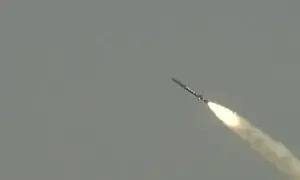
LONDON: Russia said on Wednesday it had conducted a first test launch of its Sarmat intercontinental ballistic missile, a new addition to its nuclear arsenal which President Vladimir Putin said would give Moscow’s enemies something to think about.
Putin was shown on television being told by the military that the missile had been launched from Plesetsk in the country’s northwest and hit targets in the Kamchatka peninsula in the far east.
The Sarmat has been under development for years and so its test-launch is not a surprise for the West, but it comes at a moment of extreme geopolitical tension due to Russia’s eight-week-old war in Ukraine.
“The new complex has the highest tactical and technical characteristics and is capable of overcoming all modern means of anti-missile defence. It has no analogues in the world and won’t have for a long time to come,” Putin said.
“This truly unique weapon will strengthen the combat potential of our armed forces, reliably ensure Russia’s security from external threats and provide food for thought for those who, in the heat of frenzied aggressive rhetoric, try to threaten our country.” The Sarmat is a new heavy Intercontinental Ballistic Missile which Russia is expected to deploy with 10 or more warheads on each missile, according to the US Congressional Research Service.
Launching the invasion on Feb 24, Putin made a pointed reference to Russia’s nuclear forces and warned the West that any attempt to get in its way “will lead you to such consequences that you have never encountered in your history.” Days later, he ordered Russia’s nuclear forces to be put on high alert, raising concerns in the West.
United Nations Secretary General Antonio Guterres said on March 14: “The prospect of nuclear conflict, once unthinkable, is now back within the realm of possibility.” In a statement, Russia’s defence ministry said the Sarmat was fired from a silo launcher at 1512 Moscow time and the training warheads reached a test range on Kamchatka in the Pacific, a distance of nearly 6,000 km (3,700 miles).
“Sarmat is the most powerful missile with the longest range of destruction of targets in the world, which will significantly increase the combat power of our country’s strategic nuclear forces,” it said.
Published in Dawn, April 21st, 2022