42
42

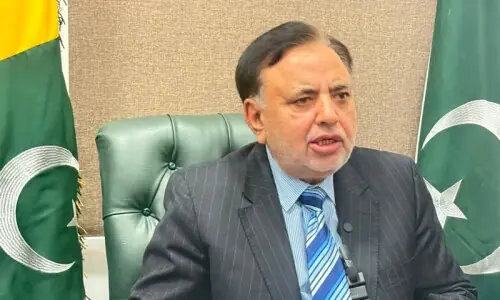
WITH the political temperature at fever pitch, the DG ISPR’s press conference yesterday will act as a cold press on some of the more worrisome narratives shoe-horned into our political discourse over the past few weeks.
Maj Gen Babar Iftikhar has made it quite clear that the security apparatus does not believe there is any imminent threat to national security or credible evidence of an international conspiracy through which Mr Imran Khan was ousted. Unless the PTI decides to counter with confrontation, the military’s statement will deflate the alarmist narrative pushed by Mr Khan about Pakistan’s sovereignty being compromised with the help of his political rivals.
Read: Foreign interference
Since Mr Khan’s unceremonious ouster, the military has been on the receiving end of a barrage of criticism, both engineered and genuine. Its senior command’s loyalty has been called into question through various trends on social media — “amplified”, the DG ISPR says, by inimical forces seemingly looking to capitalise on Pakistan’s internal turmoil. The onslaught seems to have forced the military’s hand to go public with a counter-narrative.
Read: The curious case of anti-state smear campaigns on Twitter
With the establishment taking a position on Cablegate, the message to the ousted prime minister is quite clear: Mr Khan should modulate the strident tone taken by him in recent political speeches and avoid adding to tensions between the military and the citizenry.
Other ‘clarifications’ have also been provided, such as the assertion that the army never gave Mr Khan any ‘options’ in the lead-up to his ouster; only discussed the different scenarios he would face. The DG ISPR also rubbished reports that the army chief had met opposition leaders ahead of the vote, as well as a story that suggested that he had paid a tense visit to Mr Khan hours before the latter lost his government. The ISPR’s strong assertion that the army chief is not seeking an extension and will retire in November also seems directed at countering public speculation on why the PTI government was sent packing.
The military has had a pernicious habit of political meddling throughout the brief and interrupted history of Pakistan’s democracy — something the DG ISPR indirectly acknowledged. For far too long, non-democratic forces have acted as spoilers and crippled the progress of parliamentary democracy either by using political parties against each other or directly subverting the political system.
It is high time that the space snatched away from democratic forces was returned to their hands. If the military’s new policy is indeed the paradigm shift away from past practices as it is claimed to be, it should be proven with a complete withdrawal of the military from democratic processes as well as the dismantling of political cells in the intelligence apparatus which are used to manipulate the system from behind the scenes. The upcoming general election will be a litmus test for how long this new policy endures.
Published in Dawn, April 15th, 2022