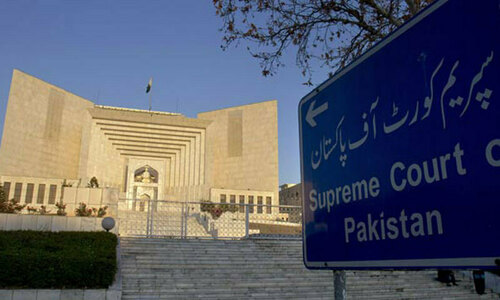
ISLAMABAD: The Supreme Court has issued a detailed verdict of its December short order in which it reinstated thousands of government employees, who had been sacked through its earlier August judgement that struck down the Sacked Employees (Reinstatement) Act 2010.
In the late-night detailed verdict, the apex court explained that the sacked government employees were restored in their positions from Aug 17, 2021 since they deserved leniency for rendering their services for 10 years or more. It said the employees were nearing retirement and had minimal job prospects.
In its Dec 17 short order, the Supreme Court dismissed review petitions filed against the August verdict, declaring that the 2010 act “is held to be in violation of, inter alia, Articles 25, 18, 9 and 4 of the Constitution of Islamic Republic of Pakistan, 1973 and therefore void under the provisions of Article 8”.
Passed with a majority of four to one, the verdict dismissed 108 petitions, rendering almost 16,000 government workers jobless.
However, the dissenting member, Justice Syed Mansoor Ali Shah, allowed review petitions against the August ruling. He emphasised that parliamentary sovereignty or legislative supremacy was the cornerstone of a strong democracy and therefore the judiciary must recognise the central role of the legislature.
Authored by Chief Justice of Pakistan Umar Ata Bandial, the detailed majority judgement observed that it was no fault of these employees since the beneficiary employees were inducted and subsequently reinstated into the service of their employers without the fulfilment of the necessary codal formalities.
Therefore, in exercise of our inherent power conferred under Order XXXIII, Rule 6 of the Supreme Court Rules of 1980 and in reliance on our power to do ex debito justitiae (as a matter of right), the employees were reinstated.
The judgement said the Supreme Court could not be precluded from converting one type of proceedings into another type, including the existing review proceedings under Article 185(3) of the Constitution and exercising our jurisdiction under Article 184(3).
“The courts are sanctuaries of justice and in exercise of authority to do ex debito justitiae to remedy a wrong and to suppress a mischief to which a litigant is entitled to,” the judgement observed. “Therefore, no fetters or bar could be placed on the high court or the Supreme Court to convert and treat one type of proceeding into another type and proceed to decide the matter.”
The copies of the judgement were also sent to the employers concerned, the Ministry of Law and Justice and the establishment division for appropriate action.
Published in Dawn, March 27th, 2022