EU imposes ‘severe’ sanctions on Russia


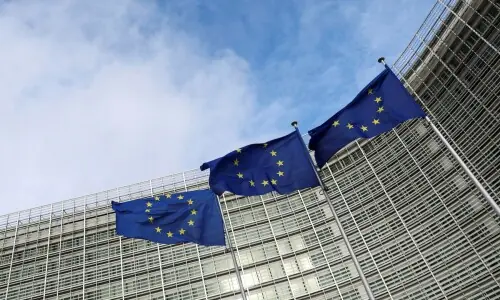
LONDON: Even as EU leaders wrapped up an emergency summit on Friday with agreement to punish Moscow for its invasion of Ukraine by imposing “severe” sanctions targeting its financial, energy and transport sectors, Britain and nine other European defence allies agreed that further sanctions were needed on Russia.
Prime Minister Boris Johnson told the so-called Joint Expeditionary Force (JEF) bloc — which includes Baltic and Scandinavian states — that the crisis “was a defining moment in European history”.
“The leaders agreed that more sanctions were needed, including focusing on (Russian) President (Vladimir) Putin’s inner circle, building on the measures that had already been agreed,” his Downing Street office said following the call.
The JEF, set up in 2012, is made up of Nato members Denmark, Estonia, Iceland, Latvia, Lithuania, the Netherlands, Norway, and the United Kingdom, and non-members Finland and Sweden. It is focused on security in the “High North” region around the Arctic, the North Atlantic and the Baltic Sea area.
The warnings about targeted sanctions on Kremlin leaders came as the EU agreed to freeze European assets linked to Putin and his Foreign Minister Sergei Lavrov, officials and a European diplomat said.
Chinese president talks to Russian leader, says crisis should be resolved peacefully
It also followed the bloc, Britain, and the United States unveiling a range of sanctions on Thursday, further targeting Russia’s banking sector and its oligarchs.
After the EU summit, European Commission chief Ursula von der Leyen told a media conference that the measures agreed “will have maximum impact on the Russian economy and the political elite”.
The summit started on Thursday night. Ukrainian President Volodymyr Zelensky addressed the gathering by video-link, telling European presidents and prime ministers that “he does not know if he will be able to speak with us another time,” Luxembourg’s leader Xavier Bettel recalled as he left.
Von der Leyen said the package of sanctions — the second adopted this week by the EU — is “targeting 70 per cent of the Russian banking market, but also key state-owned companies including the field of defence”.
She did not go into details, but a list drawn up by her commission proposed adding two Russian private banks — Alfa Bank and Bank Otkritie — to entities sanctioned by the EU.
It also called for Russians to be prohibited from putting deposits over 100,000 euros in EU banks or from purchasing euro-denominated securities.
The measures included an export ban on equipment and technology Russia needs to upgrade its oil refineries. An export ban on aircraft and plane parts to Russian airlines would also “degrade a key sector of Russia’s economy and the country’s connectivity,” von der Leyen said.
“The fourth point is we are limiting Russia’s access to crucial technology — we will hit Russia’s access to important technologies it needs to build a prosperous future such as semiconductors or cutting edge technologies,” she said.
“And finally, on visas, diplomats and related groups and business people will no longer have privileged access to the European Union.”
Presidents of China, Turkey
China’s President Xi Jinping said he supported solving the Ukraine crisis through talks in a call with Russian President Vladimir Putin, state media said on Friday.
In a readout of the call on state broadcaster CCTV, Xi pointed out that the “situation in eastern Ukraine has undergone rapid changes... (and) China supports Russia and Ukraine to resolve the issue through negotiation”.
For his part, Turkish President Recep Tayyip Erdogan accused Nato and the European Union of failing to take a “determined stance” on the Russian invasion of Ukraine.
“Nato should have taken a more decisive step,” Erdogan, whose country is a member of the military alliance, told reporters.
“The EU and other pro-Western (bodies) have failed to take a serious and determined stance at the moment. They are all providing Ukraine with plenty of advice.” Turkey has friendly ties with Russia and Ukraine and positioned itself as a neutral mediator for a resolution to the crisis.
Pope visits Russian embassy
Pope Francis went to the Russian embassy at the Holy See “to express his concern for the war” following the invasion of Ukraine, the Vatican press office said.
Francis, head of the Roman Catholic Church, stayed for just over half an hour at the embassy in Rome, the press office said, without providing a read-out of the meeting or stating who was present.
Francis’s unannounced visit comes one day after the Vatican’s secretary of state insisted there was “still time for goodwill... still room for negotiation”.
Published in Dawn, February 26th, 2022