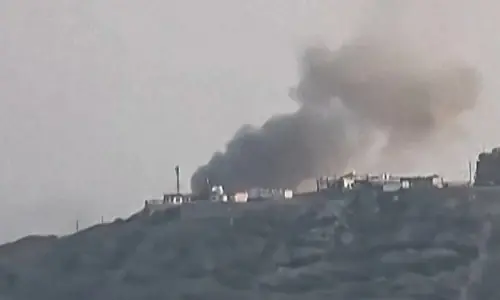
NEXT month marks the completion of the seventh year of the Yemen war, when the Saudi-led coalition intervened to support the government and dislodge the Iran-allied Houthi rebel movement that had taken Sana’a, the capital. For the people of Yemen, these seven years have proved to be a living nightmare, as death, hunger and disease have enveloped them from all sides, while there is no sign of hostilities ending. If anything, in recent days bloodshed has increased. UN officials have said that January saw the highest toll in three years, as over 650 civilians were either killed or wounded in the month. This included a devastating air strike on a detention centre in the northern Houthi stronghold of Saada, causing dozens of fatalities. That atrocity came in the wake of Houthi attacks on the UAE, in which at least three foreign workers — including a Pakistani — were killed. The UN’s special envoy noted that there had been an “alarming increase” in air strikes, including those targeting residential areas in Yemen. While both sides have targeted non-combatants, the coalition’s repeated attacks — despite having high-tech Western weaponry — have resulted in unacceptable civilian deaths. Moreover, millions in Yemen face famine in the midst of this brutal war.
The aim of the Saudi-led, Western-backed coalition was to restore the Yemeni government. Seven years down the line, this goal seems very difficult to attain in the present circumstances, with the Houthis firmly ensconced in their strongholds as well as the capital. Moreover, as the stalemate continues the conflict risks transforming into a regional war as the Houthis hit targets deeper inside the UAE and Saudi Arabia, while the coalition countries respond with ruinous air strikes targeting Yemen. For the sake of the people of Yemen, an immediate ceasefire needs to be declared by all Yemeni factions and foreign forces. Far too many lives have been lost in this pointless war, and only a negotiated power-sharing agreement, respected by all Yemeni factions and their foreign backers, can resolve the country’s crisis.
Published in Dawn, February 18th, 2022